
CUETMOCK
  • Pricing
  • Mentors
Log inStart freeStart free mocks→

First test, then trust

Try a free CUET mock test.

Join 5,00,000+ students who rehearsed exam day on the exact NTA screen before sitting CUET. On the web and on Android.

Start free mocks →Get the Android app
CUETMOCK

India's #1 CUET Mock Test Platform. Original NCERT-based questions on the exact NTA exam screen — trusted by 5,00,000+ students since CUET 2022.

Get it onGoogle PlayScan to download the CUETMOCK app

Mock tests

  • CUET mock test series
  • Commerce mocks
  • Humanities (Arts) mocks
  • Science mocks
  • Languages & GAT mocks
  • Free practice questions
  • Pricing

Resources

  • CUET exam guide
  • CUET syllabus
  • Universities accepting CUET
  • Expert blogs
  • News & notifications
  • Webinars & counselling
  • CUET score calculator
  • How we estimate your rank
  • FAQs

Company

  • About us
  • Our leadership & team
  • Our toppers
  • Mentors
  • For schools
  • Contact us
  • Terms
  • Privacy
  • Refund policy

Talk to us

+91 7696 6630 56info@cuetmock.comWhatsApp us

Our other platforms

  • JEE Mock — For IIT-JEE aspirants
  • NEET Mock — For NEET aspirants

Newsletter

Exam updates, study material and offers — no spam.

© 2026 NYC Ventures Pvt. Ltd.

701-702, Royal Business Park, Zirakpur, Punjab - 140603

  • Terms of use
  • Privacy policy
  • Refund policy
  • Contact us

iCUETMOCK is an independent preparation platform, not affiliated with the National Testing Agency (NTA). Always check exam details on the official NTA website.

  • Home
  • Mock tests
  • CUET guide
  • Pricing
  • Log in
Home/Practice questions/Chemistry
ChemistryOrganic: Alcohols, Phenols and Ethers

The final product for the following reaction is CH3CH2OH xrightarrow[…

Alcohols, Phenols and Ethers

Alcohols and phenols are formed when a hydrogen atom in a hydrocarbon, aliphatic and aromatic respectively, is replaced by –OH group. These classes of compounds find wide applications in industry as well as in day-to-day life. For instance, have you ever noticed that ordinary spirit used for polishing wooden furniture is chiefly a compound containing hydroxyl group, ethanol. The sugar we eat, the cotton used for fabrics, the paper we use for writing, are all made up of compounds containing –OH groups. The common name of an alcohol is derived from the common name of the alkyl group and adding the word alcohol to it. For example, CH3OH is methyl alcohol. The simplest hydroxy derivative of benzene is phenol. It is its common name and also an accepted IUPAC name. As structure of phenol involves a benzene ring, in its substituted compounds the terms ortho (1,2-disubstituted), meta (1,3-disubstituted) and para (1,4-disubstituted) are often used in the common names.

In ethers, the four electron pairs, i.e., the two bond pairs and two lone pairs of electrons on oxygen are arranged approximately in a tetrahedral arrangement. The bond angle is slightly greater than the tetrahedral angle due to the repulsive interaction between the two bulky (–R) groups.

The final product for the following reaction is

\( \ce{CH3CH2OH} \xrightarrow[\text{573K}]{\ce{Cu}} ? \)

Answer & explanation+

Correct answer: option 1

The correct answer is Option (1) → ethanal (CH3CHO)

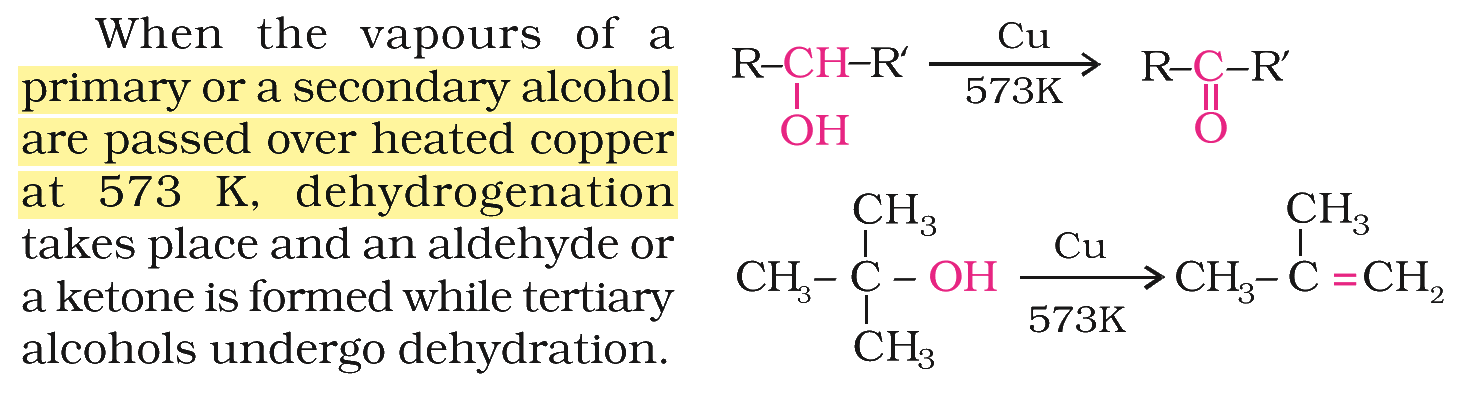
When the vapours of an alcohol are passed over heated copper at 573 K, the alcohol loses hydrogen (dehydrogenation). The product depends on the class of alcohol:

  • Primary alcohol → aldehyde

  • Secondary alcohol → ketone

  • Tertiary alcohol → alkene, because the carbon carrying –OH has no hydrogen to lose, so dehydration takes place instead

Ethanol is a primary alcohol, so it gives ethanal:

    \( \displaystyle \ce{CH3CH2OH} \xrightarrow[\text{573 K}]{\ce{Cu}} \ce{CH3CHO + H2} \)

The product keeps both carbon atoms of ethanol. So the final product is ethanal.

Why the other options are incorrect

  • Option (2) propanone (CH3COCH3) — Incorrect. It has three carbon atoms and is the product from the secondary alcohol propan-2-ol.

  • Option (3) methanal (HCHO) — Incorrect. It has only one carbon atom and is formed from methanol.

  • Option (4) propanal (CH3CH2CHO) — Incorrect. It has three carbon atoms and is formed from propan-1-ol.

NCERT (2026-27 edition):
Chemical Reactions – …
Textbook extract

Advertisement

Practise more on Organic: Alcohols, Phenols and Ethers

Chapter-wise mocks on the real NTA exam screen, with solutions and your rank. Your first mocks are free.

Start free mocks →

Advertisement

Next questions

  1. Match List-I with List-IIList-IList-II(Demonstration)(Phenomena)(A)Wave nature of light(I)Dispersion of light(B)Particle nature of light(II…Physics · Wave Optics
  2. Consider the following statements regarding resource classification based on origin-(A) Biotic resources are obtained from the biosphere an…General Aptitude Test · General Knowledge
  3. Identify the correct one word for the following expression:One who speaks many languages-English · One Word
  4. Goodwill already exist in the books is written off by:Accountancy Part A · Admission of a Partner
  5. Which of the following type of wasteland is caused mainly by human factors?Geography · India-People and Economy: Land resources and Agriculture
  6. Which of the following statements are TRUE?A. ∫_4^9 1/(√x) dx=2 B. ∫_-4^4 (x^101+x^201+x^301) dx=4≤ft(displaystyle1/102+displaystyle1/202+d…Applied Maths. Section A · Definite Integration (Section A)
  7. Arrange the following materials in increasing order of their number density (per m^-3 ) of electrons.A. n-type Silicon semiconductorB. meta…Physics · Semiconductors and Electronic Devices
  8. An example of ligand which has two different donor atoms and either of the two ligates in the complex is _____Chemistry · Inorganic: Coordination Compounds
  9. Which of the following social movements enabled Nikita and many others like her to make a police complaint when faced with violence from th…Sociology · Social Change and Development in India: Social Movements
  10. The simple interest on a sum of money at 6.25% per annum for 8 years is half of the sum. The sum is______.General Aptitude Test · Numerical Ability