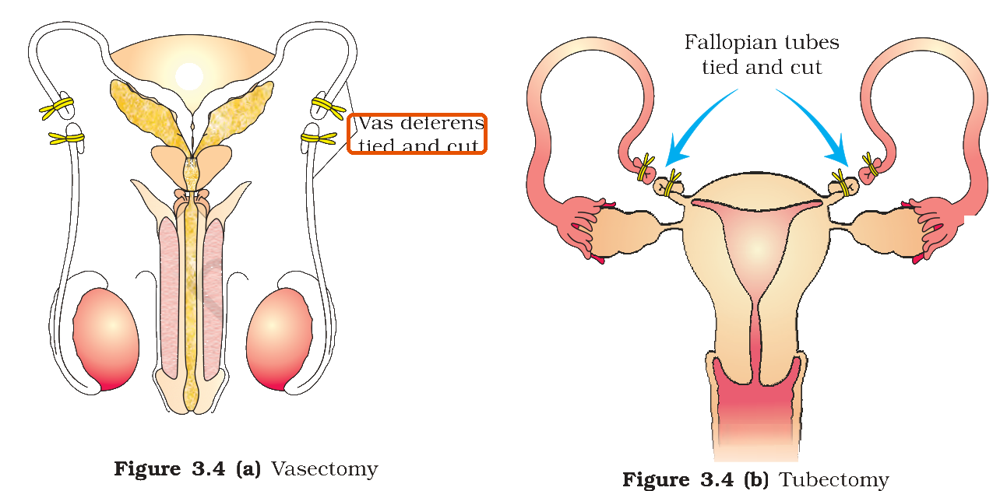
In vasectomy, which part of the reproductive organ is removed or tied up?
Answer & explanation
Correct answer: option 2
The correct answer is Option (2) → Vas deferens
Vasectomy is a method of male sterilisation. A small part of the vas deferens, the tube that carries sperms from the epididymis, is cut and removed or tied up. Sperms then cannot reach the semen, so fertilisation cannot take place.
(1) Seminal vesicles — Incorrect. These are glands that add fluid to the semen. They are left as they are.
(2) Vas deferens — Correct. This is the part removed or tied up in vasectomy.
(3) Oviduct — Incorrect. The oviduct (fallopian tube) is a female part. The matching operation in the female is tubectomy.
(4) Testis — Incorrect. The testis makes the sperms and the male hormones. It is not touched.
NCERT Extract:
Population Stabilisation and Birth Control – “… Surgical methods, also called sterilisation, are generally advised for the male/female partner as a terminal method to prevent any more pregnancies. Surgical intervention blocks gamete transport and thereby prevent conception. Sterilisation procedure in the male is called ‘vasectomy’ and that in the female, ‘tubectomy’. In vasectomy, a small part of the vas deferens is removed or tied up through a small incision on the scrotum (Figure 3.4a) whereas in tubectomy, a small part of the fallopian tube is removed (Figure 3.4b) or tied up through a small incision in the abdomen or through vagina.”