How many sperms are produced from 25 secondary spermatocytes?
Answer & explanation
Correct answer: option 1
The correct answer is Option (1) → 50
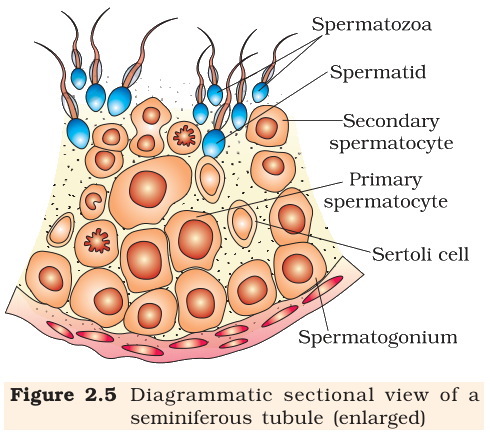
In spermatogenesis, a diploid primary spermatocyte completes the first meiotic division and forms two haploid secondary spermatocytes. Each secondary spermatocyte then completes the second meiotic division and forms two spermatids. Each spermatid changes into one sperm (spermiogenesis), so the number of sperms equals the number of spermatids.
1 secondary spermatocyte → 2 spermatids → 2 sperms
25 secondary spermatocytes → 25 × 2 = 50 sperms
A common slip is to use the figure for a primary spermatocyte. One primary spermatocyte gives four sperms, so 25 primary spermatocytes would give 100.
NCERT Extract:
Gametogenesis – “… A primary spermatocyte completes the first meiotic division (reduction division) leading to formation of two equal, haploid cells called secondary spermatocytes, which have only 23 chromosomes each. The secondary spermatocytes undergo the second meiotic division to produce four equal, haploid spermatids (Figure 2.5).”