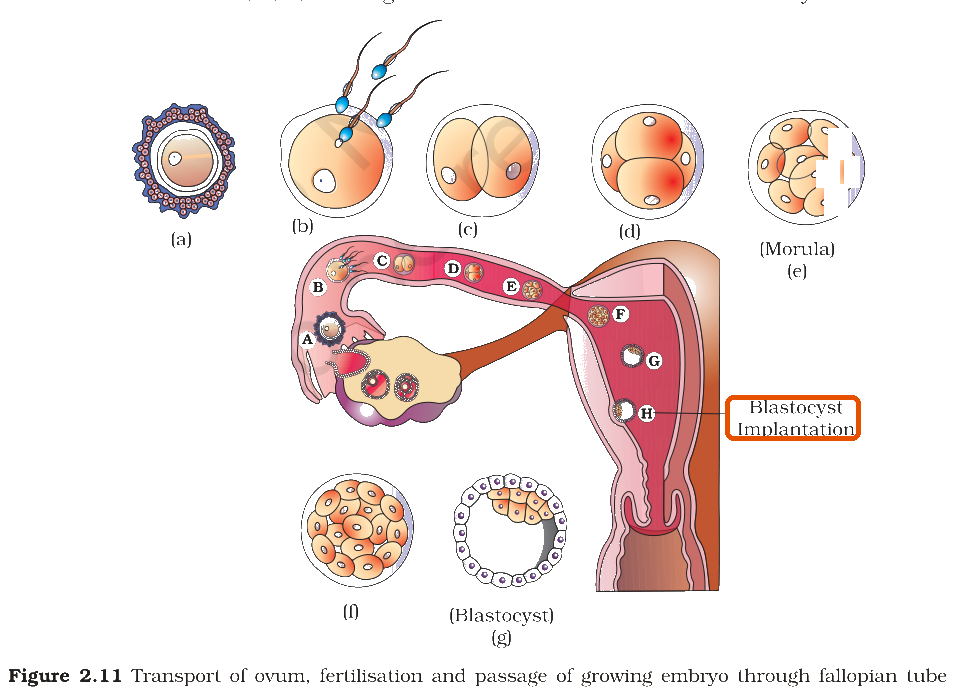
Identify the process when blastocyst is embedded in the endometrium of the uterus.
Answer & explanation
Correct answer: option 1
The correct answer is Option (1) → Implantation
(1) Implantation — Correct. The blastocyst attaches to the wall of the uterus through its outer layer, the trophoblast. The uterine cells then divide rapidly and cover it, so the blastocyst becomes embedded in the endometrium. This is implantation, and it leads to pregnancy.
(2) Fertilisation — Incorrect. Fertilisation is the fusion of a sperm with the ovum. It happens in the ampullary region of the fallopian tube and forms the zygote, long before any blastocyst exists.
(3) Cleavage — Incorrect. Cleavage is the series of mitotic divisions of the zygote as it moves towards the uterus. It forms 2, 4, 8 and 16 cells (blastomeres), then the morula, then the blastocyst. It comes before implantation.
(4) Lactation — Incorrect. Lactation is the production of milk by the mammary glands after the baby is born.
Note: A similar question was also asked in CUET (UG) 2025 on 13-05-2025 (Slot 2).
NCERT Extract:
Fertilisation and Implantation – “… The trophoblast layer then gets attached to the endometrium and the inner cell mass gets differentiated as the embryo. After attachment, the uterine cells divide rapidly and covers the blastocyst. As a result, the blastocyst becomes embedded in the endometrium of the uterus (Figure 2.11 step H). This is called implantation and it leads to pregnancy.”