Which of the following reactions is not given by phenols ?
Answer & explanation
Correct answer: option 3
The correct answer is Option (3) → Reaction with sodium bicarbonate.
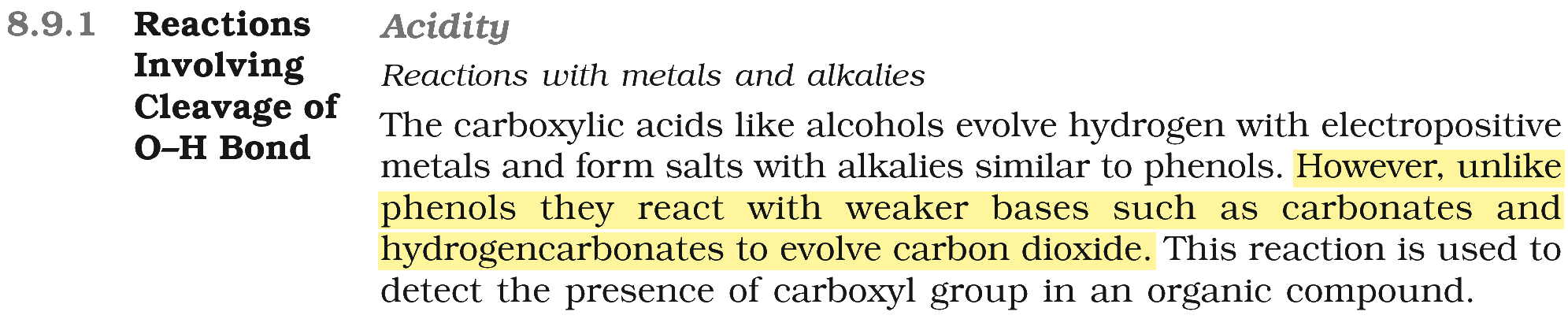
Phenol is a weak acid (pKa about 10): it gives up its O–H proton because the phenoxide ion is stabilised by resonance. An acid can release \( \ce{CO2} \) from sodium bicarbonate only if it is stronger than carbonic acid (pKa about 6.4). Phenol is weaker than carbonic acid, so it does not react with \( \ce{NaHCO3} \) and gives no effervescence.
Option (1) Reaction with sodium. — Given by phenols. Phenol, like alcohols, reacts with the active metal to give sodium phenoxide and hydrogen gas: \( \ce{2C6H5OH + 2Na -> 2C6H5ONa + H2 ^} \)
Option (2) Reaction with sodium hydroxide. — Given by phenols. Phenol is acidic enough to neutralise aqueous NaOH (alcohols are not): \( \ce{C6H5OH + NaOH -> C6H5ONa + H2O} \)
Option (3) Reaction with sodium bicarbonate. — Not given by phenols. Phenol is a weaker acid than carbonic acid, so it releases no \( \ce{CO2} \) from \( \ce{NaHCO3} \).
Option (4) Reaction with bromine water. — Given by phenols. The –OH group strongly activates the ring, so phenol gives a white precipitate of 2,4,6-tribromophenol: \( \ce{C6H5OH + 3Br2 -> C6H2Br3OH v + 3HBr} \)
NCERT (2026-27 edition):
Reactions Involving Cleavage of O–H Bond