The resistivity of three solids A, B and C are respectively 10–6 Ωm, 105 Ωm and 1015 Ωm. If (Eg)A, (Eg)B and (Eg)C represent their energy band gaps, respectively. Then, which of the following statement is true?
Answer & explanation
Correct answer: option 1
The correct answer is Option (1) → (Eg)A < (Eg)B < (Eg)C
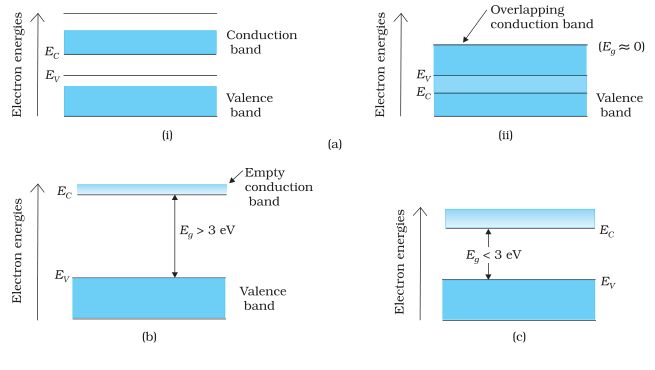
The resistivity of a solid depends on how many electrons can reach the conduction band, and that is decided by the energy band gap: the larger the gap, the higher the resistivity.
\( \rho_A = 10^{-6}\,\Omega\,\mathrm{m}\text{: conductor, bands overlap, } E_g \approx 0 \)
\( \rho_B = 10^{5}\,\Omega\,\mathrm{m}\text{: semiconductor, small gap (about 1 eV)} \)
\( \rho_C = 10^{15}\,\Omega\,\mathrm{m}\text{: insulator, large gap (more than 3 eV)} \)
Increasing resistivity means increasing band gap.
\( (E_g)_A \lt (E_g)_B \lt (E_g)_C \)
NCERT (2026-27):
Classification of Metals, Conductors and Semiconductors – “… The gap between the top of the valence band and bottom of the conduction band is called the energy band gap (Energy gap \( E_g \)). … Case I: … One can have a metal either when the conduction band is partially filled and the balanced band is partially empty or when the conduction and valance bands overlap. … Therefore, the resistance of such materials is low or the conductivity is high.
Case II: In this case, as shown in Fig. 14.2(b), a large band gap \( E_g \) exists (\( E_g \gt 3 \) eV). … This is the case of insulators.
Case III: … Here a finite but small band gap (\( E_g \lt 3 \) eV) exists. … Hence, the resistance of semiconductors is not as high as that of the insulators.”