Ohm's law does not fail, if
Answer & explanation
Correct answer: option 2
The correct answer is Option (2) → V depends on I linearly.
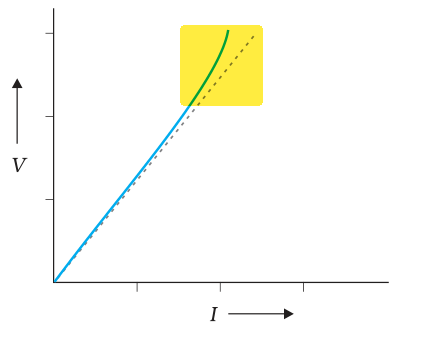
Ohm's law states that V is proportional to I, \( V = IR \), with R constant. A device obeys it only if the V–I graph is a straight line through the origin, the same for both directions of current. So the law holds when V depends on I linearly.
NCERT (2026-27):
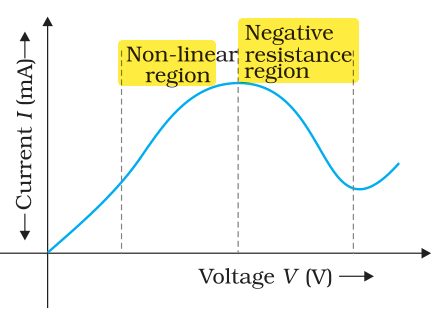
Limitations of Ohm’s Law – “Although Ohm’s law has been found valid over a large class of materials, there do exist materials and devices used in electric circuits where the proportionality of \( V \) and \( I \) does not hold. The deviations broadly are one or more of the following types:
(a) \( V \) ceases to be proportional to \( I \) (Fig. 3.5).
(b) The relation between \( V \) and \( I \) depends on the sign of \( V \).
(c) The relation between \( V \) and \( I \) is not unique, i.e., there is more than one value of \( V \) for the same current \( I \) (Fig. 3.7).”