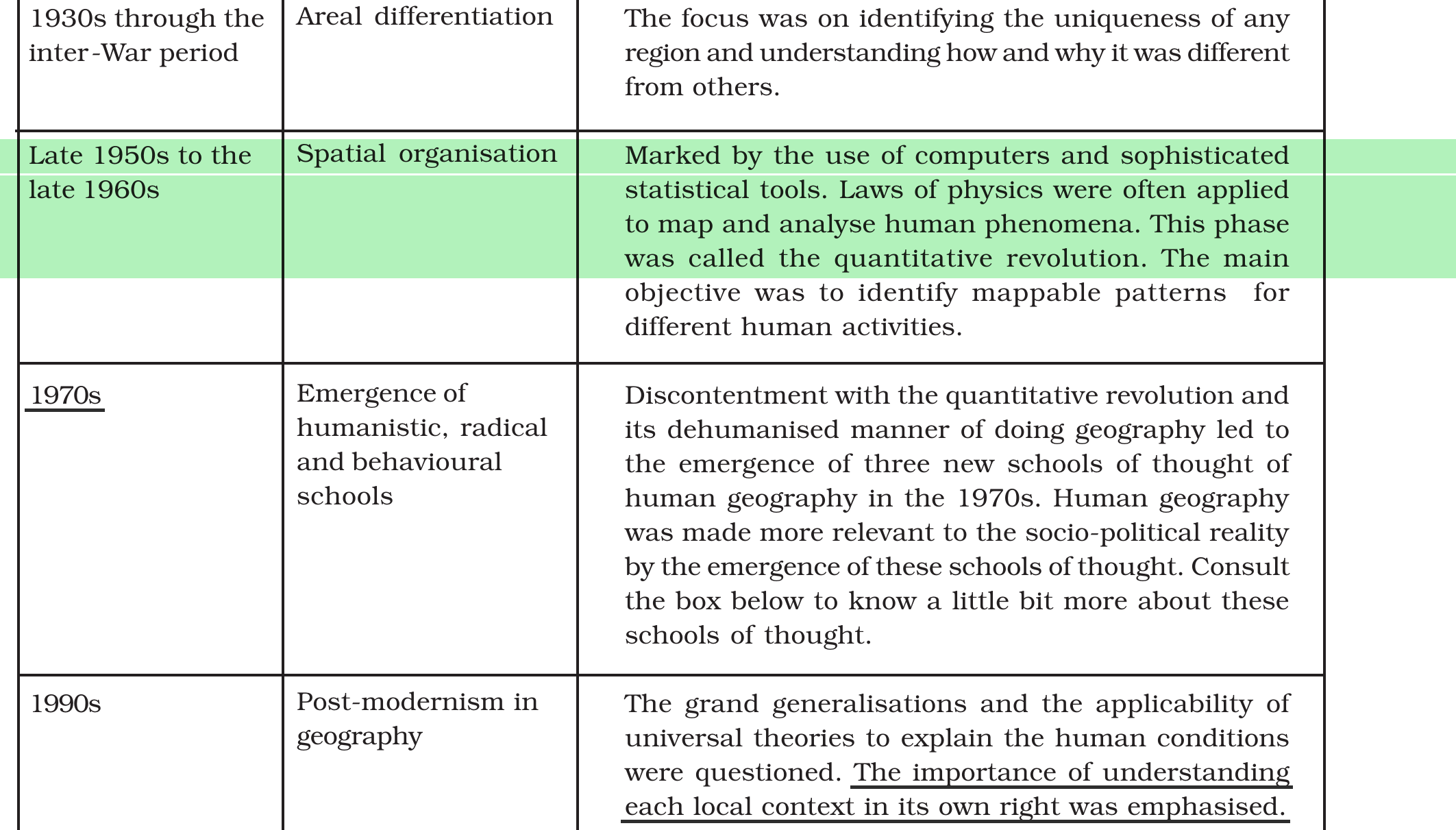
Which of the following are correct with reference to spatial organisation approach phase of Geography.
A. It dominated during 1970s and 1980s.
B. This phase was called quantitative revolution.
C. Laws of physics were often applied to map and analyse human phenomena.
D. The importance of understanding each local context was emphasised.
Choose the correct answer from the options given below:
Answer & explanation
Correct answer: option 2
The correct answer is Option (2) → B and C only
A. It dominated during 1970s and 1980s. Incorrect. Spatial organisation belongs to the late 1950s to the late 1960s. The 1970s saw the humanistic, radical and behavioural schools rise against it.
B. This phase was called quantitative revolution. Correct. Marked by computers and statistical tools, this phase was called the quantitative revolution.
C. Laws of physics were often applied to map and analyse human phenomena. Correct. The aim was to find mappable patterns of human activities.
D. The importance of understanding each local context was emphasised. Incorrect. This is the mark of post-modernism in the 1990s, which questioned the grand generalisations of the earlier phase.
NCERT: Fundamentals of Human Geography — Chapter 1: Human Geography: Nature and Scope, Table 1.1: Broad Stages and Thrust of Human Geography (continued on the page after its title) (2025-26)
|