In the context of the process of formation of a p-n junction, identify the correct statement.
Answer & explanation
Correct answer: option 1
The correct answer is Option (1) → Drift current arises due to an electric field across the p-n junction
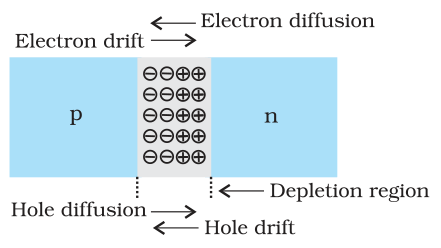
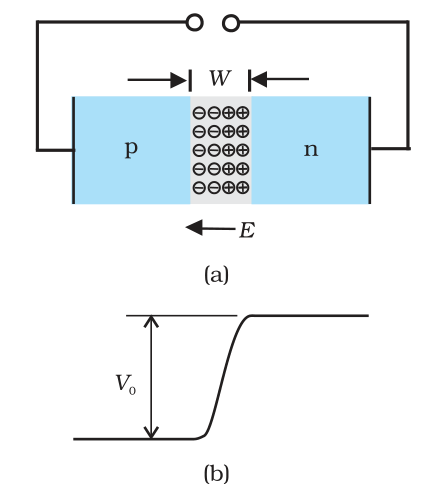
When a p-n junction forms, electrons and holes diffuse across it; the immobile ions left behind set up an electric field, which drives a drift current the other way until the two currents are equal.
Option (1) Drift current arises due to an electric field across the p-n junction — Correct. The field of the ionised donors and acceptors in the depletion layer drives the drift.
Option (2) Initially drift current is larger than the diffusion current. — Incorrect. Initially there is no field, so diffusion dominates; drift grows until it equals diffusion.
Option (3) Depletion region consists of free electrons and holes. — Incorrect. It has only immobile ions, no free carriers.
Option (4) The diffusion current is in the same direction as the drift current. — Incorrect. They are in opposite directions and cancel at equilibrium.
NCERT (2026-27):
p-n Junction Formation – “… This space-charge region on either side of the junction together is known as depletion region as the electrons and holes taking part in the initial movement across the junction depleted the region of its free charges (Fig. 14.10). … Due to the positive space-charge region on n-side of the junction and negative space charge region on p-side of the junction, an electric field directed from positive charge towards negative charge develops. … The motion of charge carriers due to the electric field is called drift. Thus a drift current, which is opposite in direction to the diffusion current (Fig. 14.10) starts.
Initially, diffusion current is large and drift current is small.”