Relative acidic strength of Carboxylic acids and their derivatives
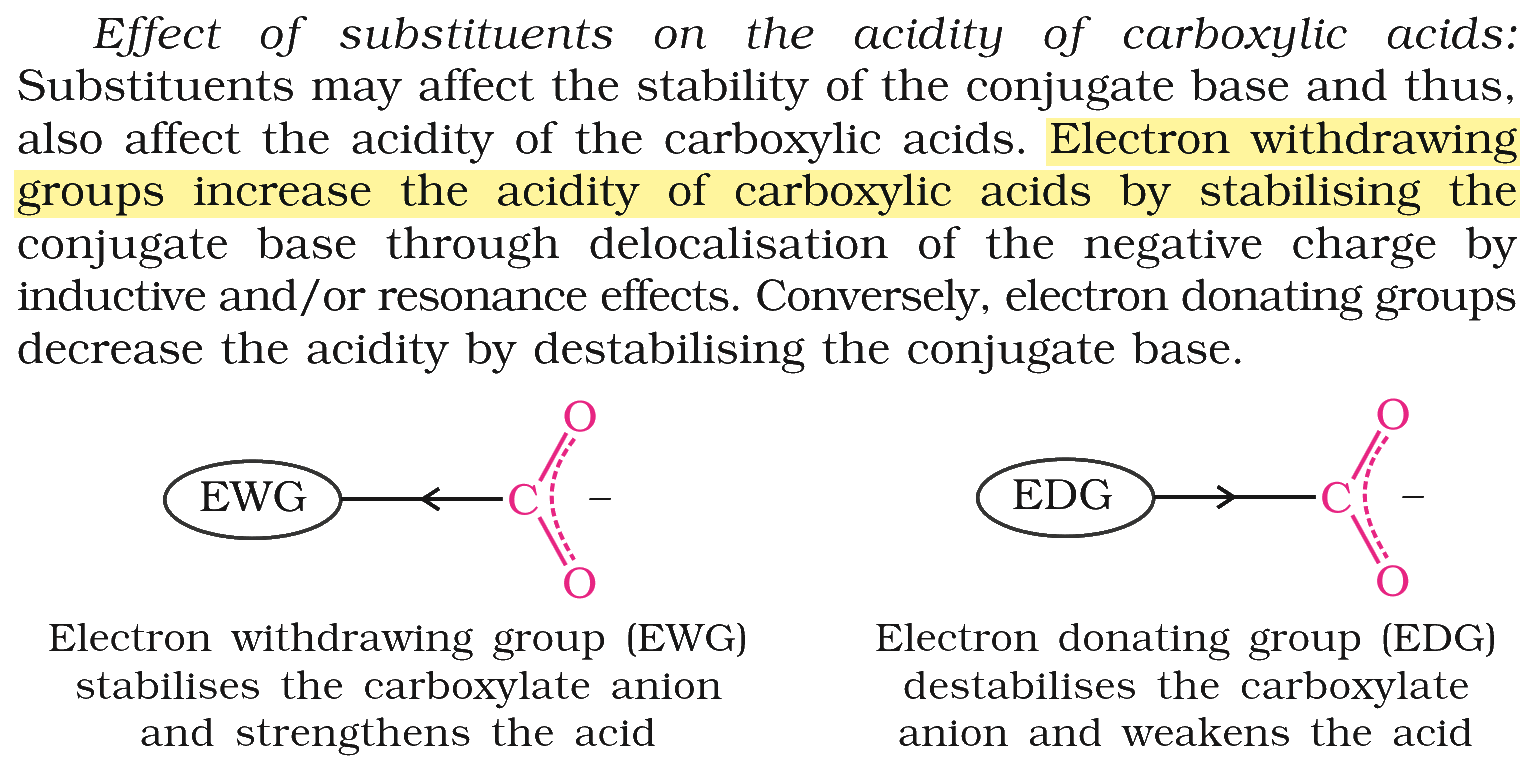
Carboxylic acids are weak acids. Mineral acids like HCl or HNO3 are very strong acids and non-edible, but many carboxylic acids are edible acids. Carboxylic acids are more acidic than phenol. The conjugate base of carboxylic acid is stabilized by two equivalent resonating structures in which the negative charge is at the more electronegative oxygen atom. Electron withdrawing group (EWG) increases the acidity of carboxylic acids while electron donating group (EDG) decreases the acidic strength of carboxylic acids. The acidic nature of carboxylic acid is also affected by direct attachment of groups such as phenyl or vinyl to the carboxylic acid. They increase the acidity of corresponding carboxylic acids.
It is due to the greater electronegativity of sp2 hybridized carbon to which carboxylic carbon is attached. This acidic character of carboxylic acid is based on its pKa values. The smaller the pka values, the stronger the acid. The effect of the following groups in increasing acidic order is
Ph < I < Br < Cl < F < CN < NO2 < CF3
Identify the strongest acid among, 4-methoxy benzoic acid, benzoic acid, acetic acid and 4-nitrobenzoic acid
Answer & explanation
Correct answer: option 1
The correct answer is Option (1) → 4-nitrobenzoic acid
The acidity of a carboxylic acid depends on the group attached to the carboxyl group:
Electron withdrawing groups (–\( \ce{NO2} \), halogens) stabilise the carboxylate ion and increase acidity.
Electron donating groups (–\( \ce{CH3} \), –\( \ce{OCH3} \)) destabilise it and decrease acidity.
A phenyl group is attached through an sp2 carbon, which is more electronegative than the sp3 carbon of a methyl group. So benzoic acid is stronger than acetic acid.
In 4-nitrobenzoic acid, the –\( \ce{NO2} \) group withdraws electrons from the ring. In 4-methoxybenzoic acid, the –\( \ce{OCH3} \) group donates electrons into the ring by resonance. The pKa values (smaller pKa means a stronger acid) give:
\( \displaystyle \text{4-nitrobenzoic acid } (3.41) > \text{benzoic acid } (4.19) \)
\( \displaystyle > \text{4-methoxybenzoic acid } (4.46) > \text{acetic acid } (4.76) \)
So the strongest acid is 4-nitrobenzoic acid.
Why the other options are incorrect
Option (2) acetic acid — Incorrect. The methyl group is electron donating and is attached through an sp3 carbon, so acetic acid is the weakest acid of the four.
Option (3) 4-methoxybenzoic acid — Incorrect. The –\( \ce{OCH3} \) group donates electrons by resonance, so this acid is weaker than benzoic acid.
Option (4) benzoic acid — Incorrect. Benzoic acid has no substituent to increase its acidity, so it is weaker than 4-nitrobenzoic acid.
NCERT (2026-27 edition):
Effect of Substituents on the Acidity of Carboxylic Acids