
CUETMOCK
  • Pricing
  • Mentors
Log inStart freeStart free mocks→

First test, then trust

Try a free CUET mock test.

Join 5,00,000+ students who rehearsed exam day on the exact NTA screen before sitting CUET. On the web and on Android.

Start free mocks →Get the Android app
CUETMOCK

India's #1 CUET Mock Test Platform. Original NCERT-based questions on the exact NTA exam screen — trusted by 5,00,000+ students since CUET 2022.

Get it onGoogle PlayScan to download the CUETMOCK app

Mock tests

  • CUET mock test series
  • Commerce mocks
  • Humanities (Arts) mocks
  • Science mocks
  • Languages & GAT mocks
  • Free practice questions
  • Pricing

Resources

  • CUET exam guide
  • CUET syllabus
  • Universities accepting CUET
  • Expert blogs
  • News & notifications
  • Webinars & counselling
  • CUET score calculator
  • How we estimate your rank
  • FAQs

Company

  • About us
  • Our leadership & team
  • Our toppers
  • Mentors
  • For schools
  • Contact us
  • Terms
  • Privacy
  • Refund policy

Talk to us

+91 7696 6630 56info@cuetmock.comWhatsApp us

Our other platforms

  • JEE Mock — For IIT-JEE aspirants
  • NEET Mock — For NEET aspirants

Newsletter

Exam updates, study material and offers — no spam.

© 2026 NYC Ventures Pvt. Ltd.

701-702, Royal Business Park, Zirakpur, Punjab - 140603

  • Terms of use
  • Privacy policy
  • Refund policy
  • Contact us

iCUETMOCK is an independent preparation platform, not affiliated with the National Testing Agency (NTA). Always check exam details on the official NTA website.

  • Home
  • Mock tests
  • CUET guide
  • Pricing
  • Log in
Home/Practice questions/Biology
BiologyMolecular Basis of Inheritance

Identify the heavy isotope used in the above experiment:

Comprehension:

Meselson and Stahl experiment

Read the following passage carefully and answer the given questions.

While proposing the double helical structure for DNA, Watson and Crick had immediately proposed a scheme for replication of DNA. To quote their original statement that is as follows: “It has not escaped our notice that the specific pairing we have postulated immediately suggests a possible copying mechanism for the genetic material” (Watson and Crick, 1953). Matthew Meselson and Franklin Stahl performed the following experiment. They grew E. coli in 15N medium and then shifted to 14N medium. After 20 minutes (One generation), DNA shows intermediate density. After 40 minutes, two bands appeared - One intermediate and one light. The study used density gradient centrifugation to demonstrate the mechanism of DNA replication. Very similar experiments involving use of radioactive thymidine to detect distribution of newly synthesised DNA in the chromosomes was performed on Vicia faba by Taylor and colleagues in 1958.

Identify the heavy isotope used in the above experiment:

Answer & explanation+

Correct answer: option 1

The correct answer is Option (1) → 15N

Meselson and Stahl grew E. coli in a medium whose only source of nitrogen was 15NH4Cl. 15N is the heavy isotope of nitrogen, and the normal nitrogen is the lighter isotope 14N. The bacteria built 15N into their new DNA, so this DNA became heavy. 15N is not a radioactive isotope. It is separated from 14N only by density.

(1) 15N — Correct. It is the heavy isotope that labelled the DNA.

(2) 14N — Incorrect. This is the normal, lighter nitrogen. The cells were moved to a medium with 14N after they had grown in 15N.

(3) 16N — Incorrect. This is not the isotope used in the experiment.

(4) 13N — Incorrect. This is not the isotope used in the experiment.

Note: The passage is taken from NCERT. NTA has put lines of the NCERT text together to make it. Most CUET (UG) questions come straight from NCERT, so study the book line by line, including figures and their titles.

NCERT Extract:
Replication – “… After the completion of replication, each DNA molecule would have one parental and one newly synthesised strand. This scheme was termed as semiconservative DNA replication (Figure 5.6).”
The Experimental Proof – “It is now proven that DNA replicates semiconservatively. It was shown first in Escherichia coli and subsequently in higher organisms, such as plants and human cells. Matthew Meselson and Franklin Stahl performed the following experiment in 1958: (i) They grew E. coli in a medium containing 15NH4Cl (15N is the heavy isotope of nitrogen) as the only nitrogen source for many generations.”
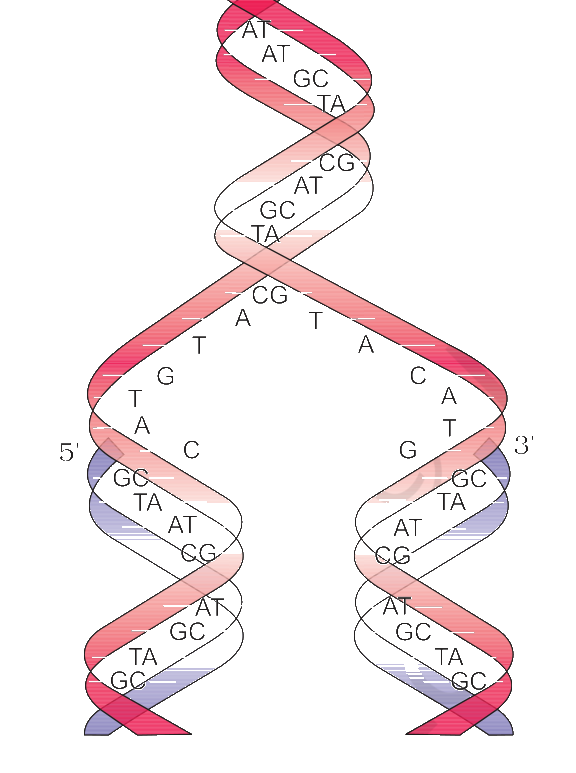
Textbook figure

Figure 5.6 Watson-Crick model for semiconservative replication

Advertisement

Practise more on Molecular Basis of Inheritance

Chapter-wise mocks on the real NTA exam screen, with solutions and your rank. Your first mocks are free.

Start free mocks →

Advertisement

Next questions

  1. Which of the following hormones is secreted by the thyroid gland?Chemistry · Organic: Biomolecules
  2. Which one of the following enzymes is used to cut the DNA molecule?Biology · Biotechnology -Principles and Processes
  3. Two charges q1 = 4 μC and q2 = 16 μC are placed 9 cm apart. At a point P between them, the electric field is zero. If a charge of 5 μC is p…Physics · Electrostatic Potential and Capacitance
  4. Choose the word that is a necessary part of 'SCHOOL':General Aptitude Test · Verbal Reasoning
  5. The density of population in India was _______ persons/sq km in 2011.Geography · India-People and Economy: Population-Distribution,Density, Growth and Composition
  6. Which one of the following approaches is used to protect and maintain threatened species?Biology · Biodiversity and Conservation
  7. In the figure as shown, a part of the wire belonging to the loop PQRS is bent into a semicircle of radius r = 0.2 m. Initially, the plane o…Physics · Electromagnetic Induction
  8. Arrange the following Oceans in descending order of area from largest to smallest (in square km)(A) Arctic Ocean(B) Indian Ocean(C) Atlanti…General Aptitude Test · General Knowledge
  9. Which one of the following statements is correct?Political Science · Contemporary World Politics: Environment and Natural Resources
  10. Arrange the following nuclei in decreasing order of their binding energy per nucleon.(A) ^32S (B) ^184W (C) ^14N (D) ^6Li Choose the correc…Physics · Nuclei