Arrange the following rate expressions (of hypothetical reactions) in the increasing arrangement of their order of reaction:
Assume the concentrations of A and B in all the rate expressions is same.
(A) Rate = k [A]1/2 [B]3/2
(B) Rate = k [A]1/2 [B]1/2
(C) Rate = k [A]3/2 [B]−1
(D) Rate = k [A]2 [B]1
Choose the correct answer from the options given below:
Answer & explanation
Correct answer: option 2
The correct answer is Option (2) → (C), (B), (A), (D)
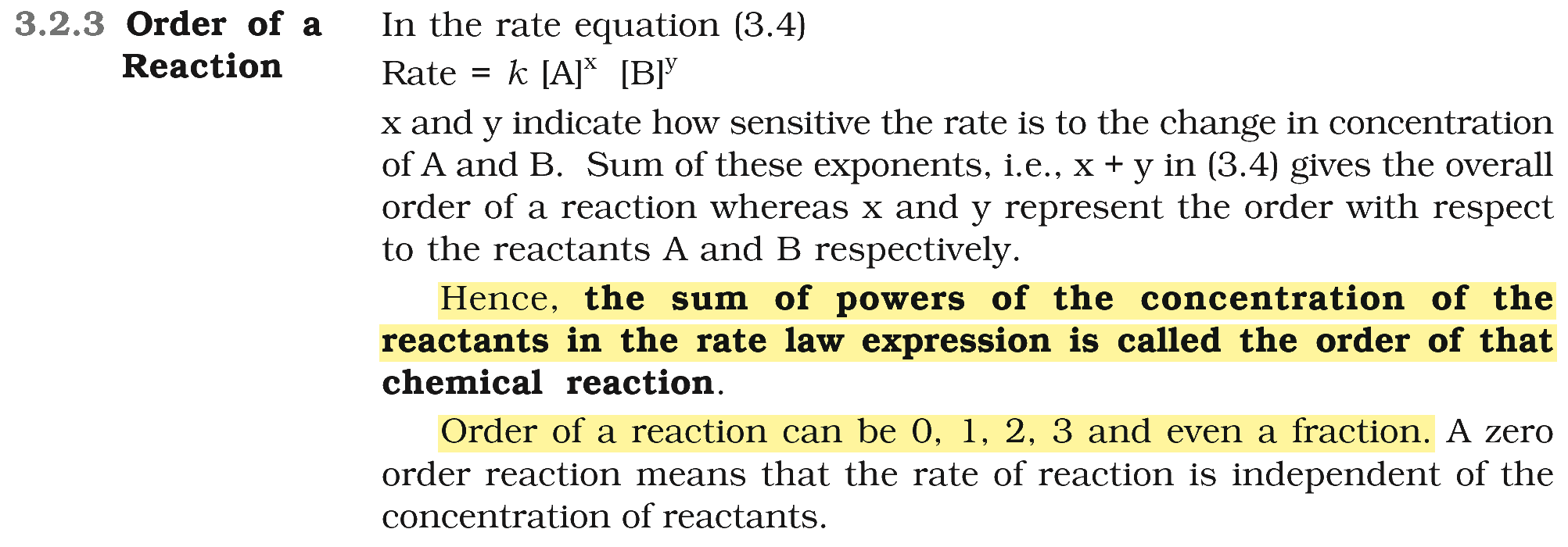
The order of a reaction is the sum of the powers of the concentration terms in the rate law:
\( \displaystyle \text{Rate}=k\,[A]^{x}[B]^{y} \Rightarrow \text{order}=x+y \)
The order is found by experiment. It can be a whole number, a fraction, zero or even negative; a negative power means that a higher concentration of that species slows the reaction down. The actual concentrations do not affect the order, so taking the concentrations of A and B as the same changes nothing here.
Adding the powers in each rate expression:
(A) Rate = k [A]1/2 [B]3/2: order = \( \displaystyle \frac{1}{2}+\frac{3}{2}=2 \)
(B) Rate = k [A]1/2 [B]1/2: order = \( \displaystyle \frac{1}{2}+\frac{1}{2}=1 \)
(C) Rate = k [A]3/2 [B]−1: order = \( \displaystyle \frac{3}{2}-1=\frac{1}{2} \)
(D) Rate = k [A]2 [B]1: order = \( \displaystyle 2+1=3 \)
Shortcut: (C) has the lowest order and (D) the highest. Only Option (2) starts with (C) and ends with (D).
NCERT (2026-27 edition):
Order of a Reaction