Read the passage carefully and answer the following questions:
Determination of Income
The major economic activities of the government that affect the aggregate demand for final goods and services can be summarized by the fiscal variables Tax (T) and Government Expenditure (G), both autonomous to our analysis. The government, through its expenditure G on final goods and services, adds to the aggregate demand like other firms and households. On the other hand, taxes imposed by the government take a part of the income away from the household, whose disposable income, therefore, becomes Yd = Y – T. Households spend only a fraction of this disposable income for consumption purpose. Hence, equation has to be modified in the following way to incorporate the government
Y = C̄ + Ī + G + c (Y – T )
Where, Y- Income, C-Consumption, G- Government Expenditure, I-Investment, c- Marginal Propensity to consume (MPC), T- tax.
Increase in Taxes will lead to__________
Answer & explanation
Correct answer: option 3
The correct answer is Option (3) → Decrease in Income
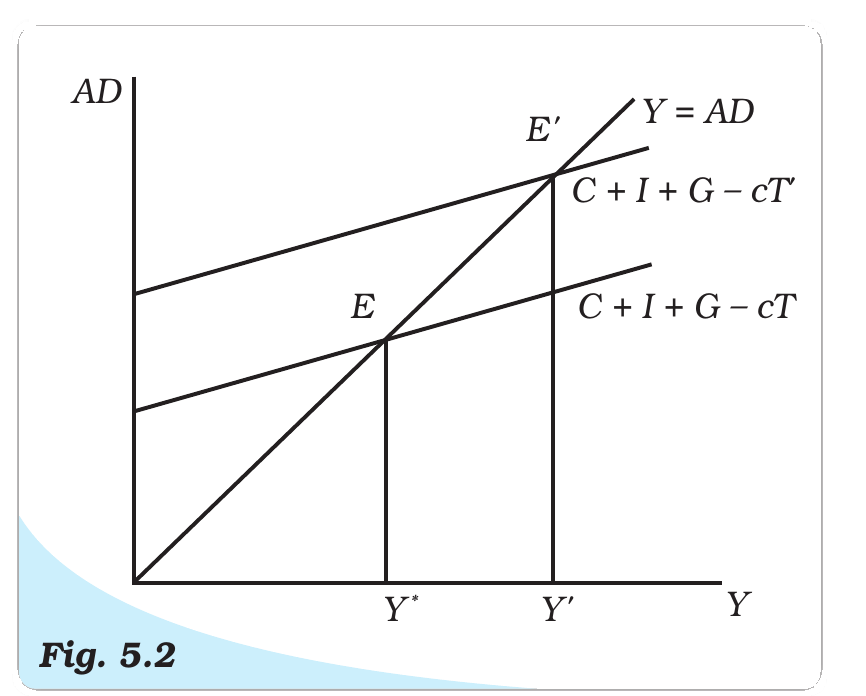
A rise in taxes cuts households’ disposable income (Y – T), so they spend less; lower spending lowers aggregate demand, and through the multiplier income falls by more than the fall in spending. This is why the tax multiplier is negative:
ΔY = [−c ÷ (1 − c)] × ΔT
Why the other options are incorrect
Option (1) Increase in Investment — Incorrect. Investment is autonomous in this model, so it does not change when taxes change.
Option (2) Increase in autonomous consumption — Incorrect. Autonomous consumption is the part of consumption that does not depend on income. A tax rise cuts the income-dependent part, c(Y – T), and leaves the autonomous part as it is.
Option (4) Increase in Income — Incorrect. A tax rise lowers consumption and aggregate demand, so income moves the other way; it is a tax cut that raises income.
NCERT (2025-26): “Changes in Taxes We find that a cut in taxes increases disposable income (Y – T ) at each level of income. This shifts the aggregate expenditure schedule upwards by a fraction c of the decrease in taxes. This is shown in Fig 5.2. From equation 5.3, we can calculate the tax multiplier using the same method as for the government expenditure multiplier. …Because a tax cut (increase) will cause an increase (reduction) in consumption and output, the tax multiplier is a negative multiplier.…”
|