d-Block elements
The d-block of the periodic table contains the elements in which the d orbitals are progressively filled in each of the four long periods. The d-block elements are also known as transition metals. Originally, the name transition metals was derived from the fact their chemical properties were transitional between those of s- and p-block elements. They show numerous oxidation states. All the transition elements exhibit typical metallic properties such as high tensile strength, ductility, malleability, thermal and electrical conductivity. Another important property of transition metals is their catalytic activity. Transition metals generally have high melting and boiling points. Many d-block elements are colored.
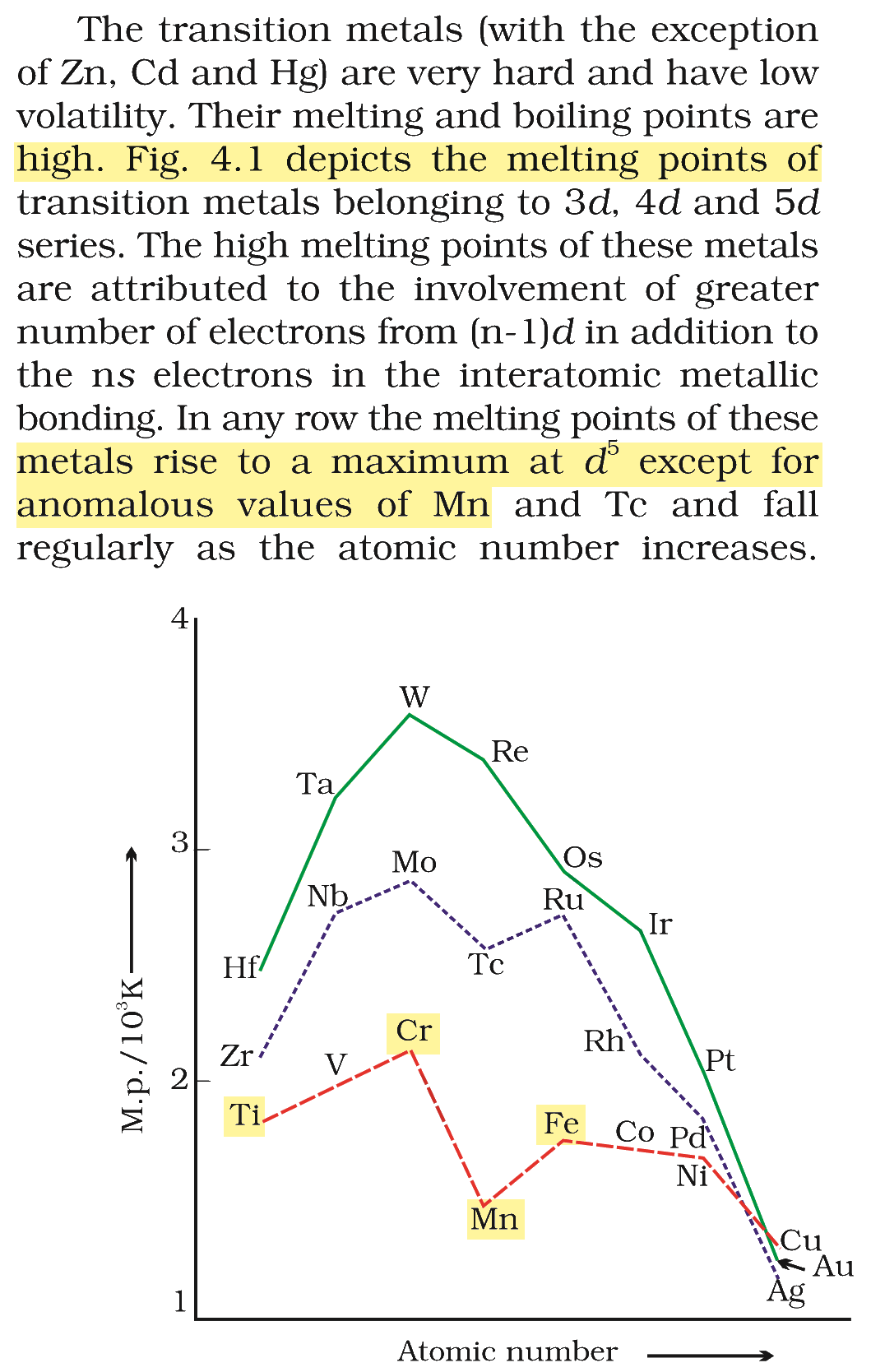
Which is the correct decreasing order of melting points of following first row transition metals?
Ti (22), Cr (24), Mn (25), Fe (26)
Answer & explanation
Correct answer: option 2
The correct answer is Option (2) → Cr, Ti , Fe, Mn
Melting points rise to a maximum near d5 because more unpaired d electrons join the metallic bonding; manganese is the exception with an unusually low value. The approximate values are:
\( \displaystyle \mathrm{Cr}\ (2180\ \mathrm{K}) > \mathrm{Ti}\ (1941\ \mathrm{K}) > \mathrm{Fe}\ (1811\ \mathrm{K}) > \mathrm{Mn}\ (1519\ \mathrm{K}) \)
Shortcut: Mn is last in every option, and Cr (the highest) is first only in Options (2) and (3). Ti melts higher than Fe, which gives Option (2).
NCERT (2026-27 edition):
Physical Properties – …