Double helix model for the structure of DNA was based on:
Answer & explanation
Correct answer: option 3
The correct answer is Option (3) → X-ray diffraction
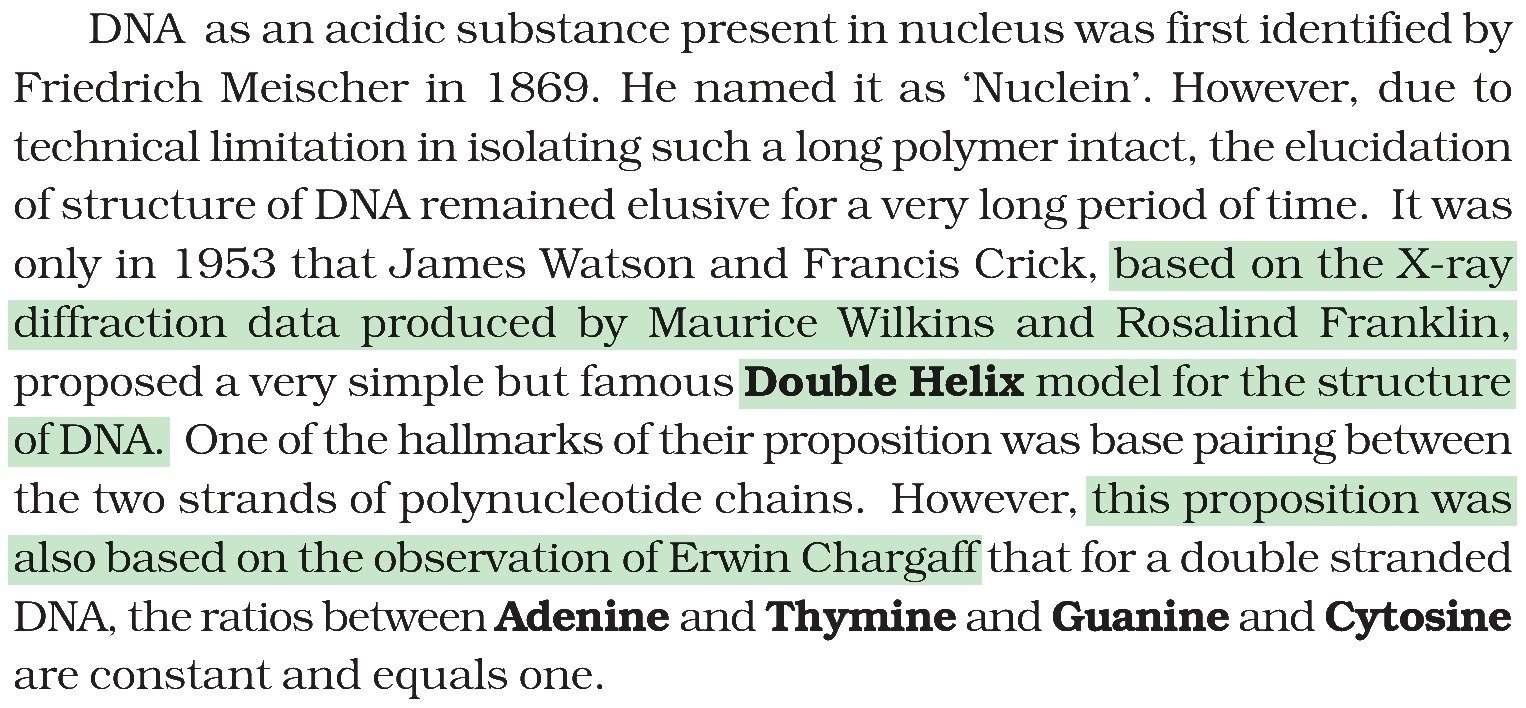
Note: The given answer is as per the official NTA Answer Key. However, the question can have more than one correct answer, i.e. both Option (3) and Option (1), because NCERT says that the double helix model was based on the X-ray diffraction data and also on Chargaff’s observation, as explained below.
In 1953, James Watson and Francis Crick proposed the double helix model of DNA. They built it on two sets of findings. The first was the X-ray diffraction data of Maurice Wilkins and Rosalind Franklin, which showed the helical shape of the molecule. The second was Chargaff’s rule: in double-stranded DNA, A equals T and G equals C, so the ratios A/T and G/C are always one. This fitted the idea of base pairing between the two strands.
(1) Chargaff’s rule — Also correct as per NCERT. NCERT says the proposition “was also based on” Chargaff’s observation, which is the basis of base pairing (A with T, G with C).
(2) Replication of DNA — Incorrect. Replication came after the model. Watson and Crick used base pairing to suggest how DNA could copy itself, and Meselson and Stahl later proved it was semi-conservative.
(3) X-ray diffraction — Correct. The model was based on the X-ray diffraction data of Wilkins and Franklin. This is the answer given by NTA.
(4) Transforming principle — Incorrect. The ‘transforming principle’ comes from Griffith’s experiment on Streptococcus pneumoniae. It was part of the search for the genetic material, not the basis of the structure of DNA.
NCERT Extract:
Structure of Polynucleotide Chain – …