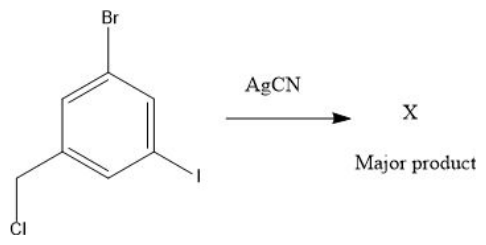
Identify the major product X in the following chemical reaction.
Answer & explanation
Correct answer: option 4
The correct answer is Option (4) → 3-bromo-5-iodobenzyl isocyanide
Two ideas decide the product:
Which halogen is replaced: a halogen attached directly to the benzene ring (aryl halide) does not undergo nucleophilic substitution under ordinary conditions. Resonance gives the C–X bond partial double bond character, and the carbon is sp2. A halogen on the –CH2– group next to the ring (benzylic halide) is very reactive. So only the –CH2Cl group reacts; Br and I on the ring stay unchanged.
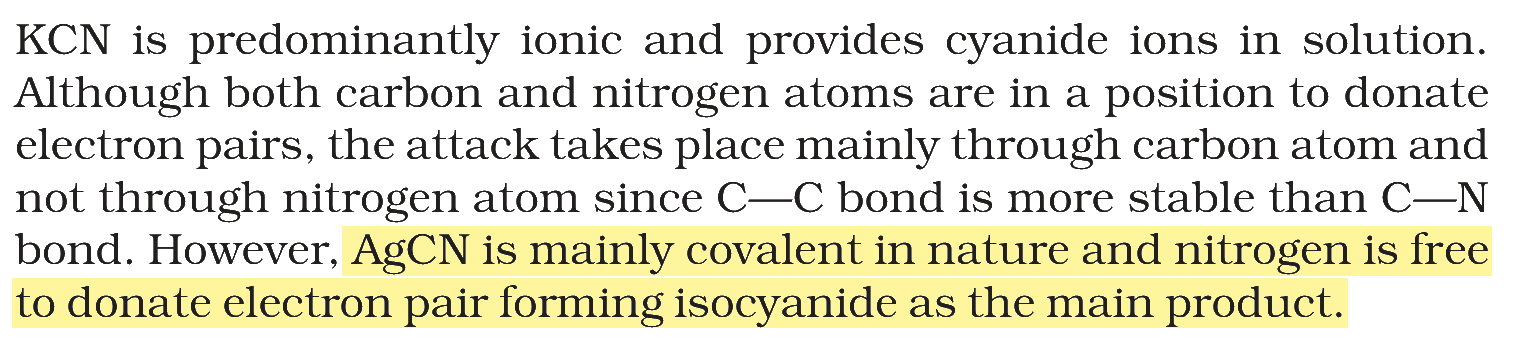
How cyanide attacks: the cyanide ion is an ambident nucleophile; it can attack through C or through N. KCN is ionic, and the free \( \ce{CN^{-}} \) attacks through carbon, giving a nitrile (R–CN). AgCN is mainly covalent (Ag–C bond), so only the lone pair on nitrogen is free to attack, giving an isocyanide (R–NC).
\( \displaystyle \ce{Ar-CH2Cl + AgCN -> Ar-CH2-NC + AgCl} \)
(Ar = the 3-bromo-5-iodophenyl ring.)
So X is the compound in which only the benzylic Cl is replaced by –NC, with Br and I still on the ring: 3-bromo-5-iodobenzyl isocyanide.
Why the other options are incorrect
Option (1) 3-bromo-5-iodobenzyl cyanide — Incorrect. This nitrile (–\( \ce{CH2CN} \)) is the product with KCN, where the attack is through carbon.
\( \displaystyle \ce{Ar-CH2Cl + KCN -> Ar-CH2-CN + KCl} \)
Option (2) 3-bromo-5-(chloromethyl)benzonitrile — Incorrect. Here the ring iodine has been replaced by –CN and the –\( \ce{CH2Cl} \) group is left unchanged; aryl halides do not react this way, while the benzylic chloride does.
Option (3) 1-bromo-3-(chloromethyl)-5-isocyanobenzene — Incorrect. Here the ring iodine has been replaced by –NC; again, the aryl C–I bond is not attacked.
NCERT (2026-27 edition):
Reactions of Haloalkanes – …