Equilibrium and Level of Employment
Read the passage carefully and answer the following questions:
The equilibrium output in economy also determines level of employment, given quantities of other factors of production. This means that level of output determined by equality of Y with AD does not necessarily mean level of output at which everyone is employed. The full-employment level of income is that level of income where all factors of production are fully employed in production process. The equilibrium attained at point of equality of Y and AD by itself, does not signify full-employment of resources. Equilibrium only means that if left to itself, level of income in economy will not change even when there is unemployment in economy. The equilibrium level of output may be more or less than full-employment level of output. If it is less than full-employment of output, it is due to fact that demand is not enough to employ all factors of production; this leads to decline in prices in long run. On other hand, if equilibrium level of output is more than full-employment level, it is due to fact that demand is more than level of output produced at full-employment level; this leads to rise in prices in long run. The increment in equilibrium value of total output thus exceeds the initial increment in autonomous expenditure. The ratio of the total increment in equilibrium value of final goods output to the initial increment in autonomous expenditure is called the investment multiplier of the economy.
What are the equilibrium conditions in two-sector model?
Answer & explanation
Correct answer: option 1
The correct answer is Option (1) → Y = AD
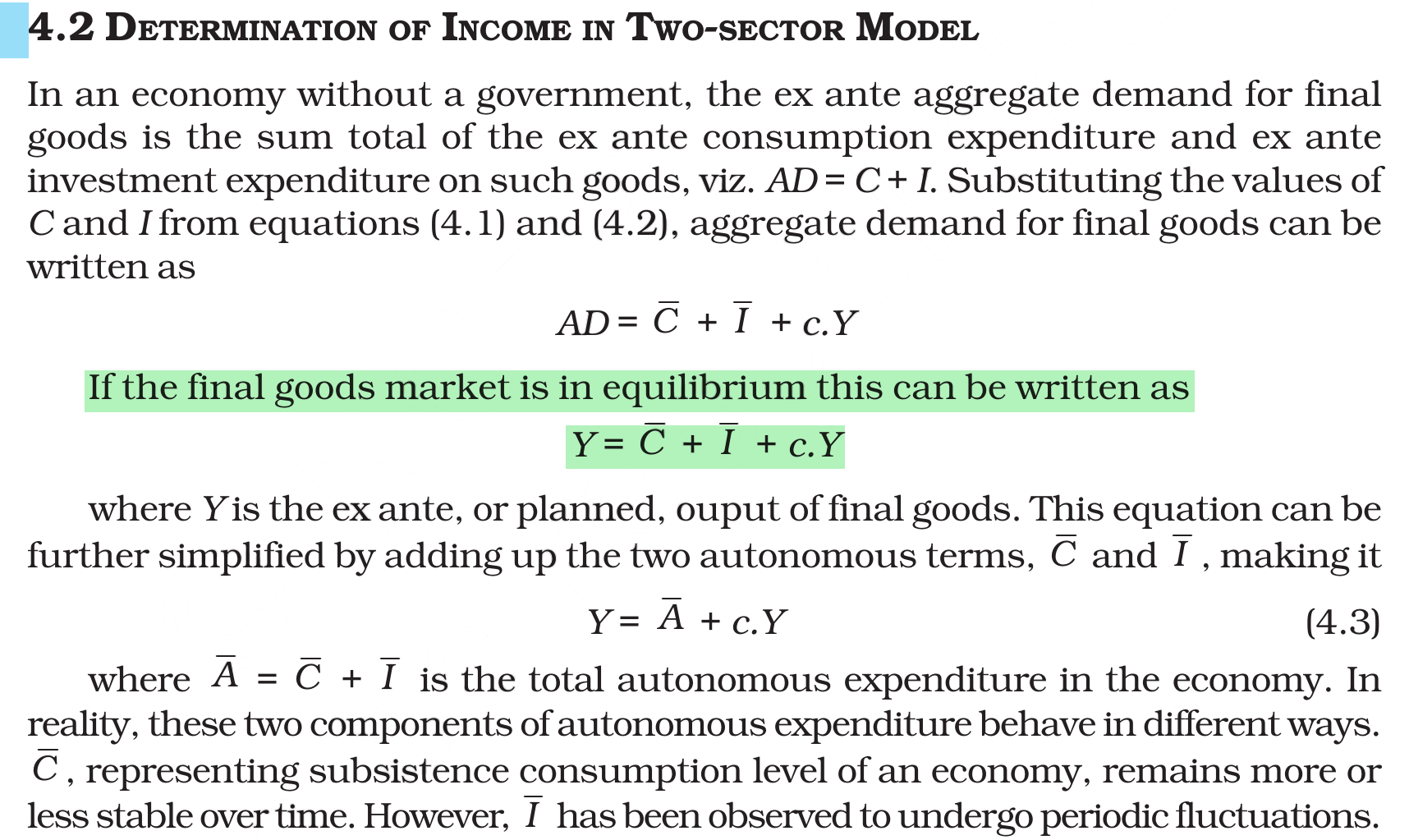
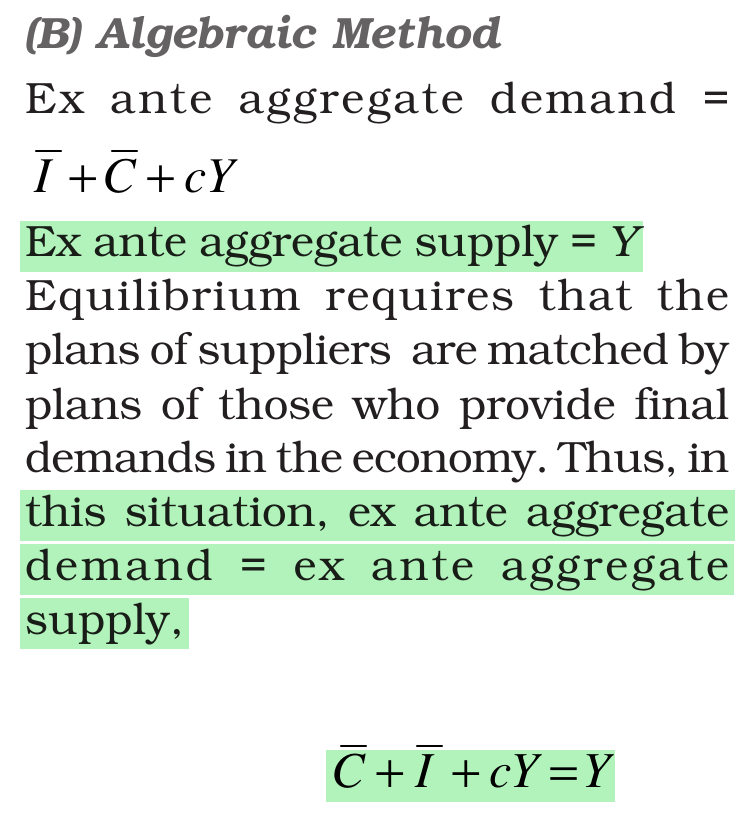
Firms plan how much to produce, and buyers plan how much to buy. The final goods market settles, with no unsold stocks and no shortage, only when the two plans agree: planned (ex ante) output equals planned (ex ante) aggregate demand, Y = AD. The passage calls this the level of output determined by the equality of Y with AD.
In the two-sector model (households and firms, no government) aggregate demand is autonomous consumption C̄, induced consumption cY and autonomous investment Ī:
AD = C̄ + Ī + cY
Equilibrium: Y = C̄ + Ī + cY
With Ā = C̄ + Ī, the total autonomous expenditure: Y = Ā + cY
Taking the options one by one:
Option (1) Y = AD — Correct. This is the equilibrium condition: output supplied equals output demanded, whatever aggregate demand is made up of.
Option (2) Y = C + I + cY — Incorrect. C stands for total consumption, which already includes the induced part cY, so this counts induced consumption twice.
Option (3) Y= A+ cY — Incorrect. As printed, A carries no bar, so it does not denote autonomous expenditure. The equilibrium of the two-sector model is Y = Ā + cY, where Ā is the total autonomous expenditure.
Option (4) AD = C + I — Incorrect. This only says what aggregate demand is made of in a two-sector economy. It is a definition, not a condition for equilibrium: it holds whether or not output equals demand.
NCERT: Introductory Macroeconomics — Chapter 4: Determination of Income and Employment (2025-26)
|