
d-Block elements
The d-block of the periodic table contains the elements in which the d orbitals are progressively filled in each of the four long periods. The d-block elements are also known as transition metals. Originally, the name transition metals was derived from the fact their chemical properties were transitional between those of s- and p-block elements. They show numerous oxidation states. All the transition elements exhibit typical metallic properties such as high tensile strength, ductility, malleability, thermal and electrical conductivity. Another important property of transition metals is their catalytic activity. Transition metals generally have high melting and boiling points. Many d-block elements are colored.
Which d-block element is not regarded as transition metal?
Answer & explanation
Correct answer: option 2
The correct answer is Option (2) → Zn
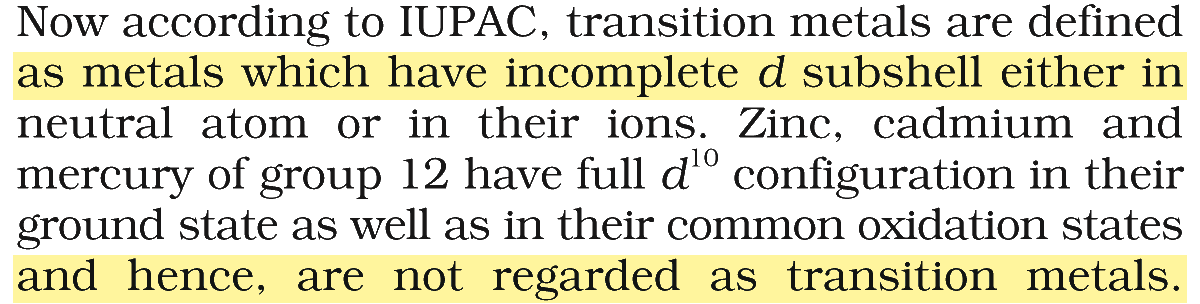
A transition metal is defined as a metal that has an incomplete d subshell either in its neutral atom or in its ions. Zinc, cadmium and mercury have a full d10 configuration in the ground state and in their common oxidation state, so they are d-block elements but are not regarded as transition metals.
Option (1) Mn — Regarded as a transition metal. Mn (Z = 25) is [Ar]3d54s2; its 3d subshell is incomplete.
Option (2) Zn — Not regarded as a transition metal. Zn (Z = 30) is [Ar]3d104s2; losing the two 4s electrons gives its only common ion, \( \ce{Zn^{2+}} \): [Ar]3d10. The d subshell is full in both the atom and the ion.
Option (3) Sc — Regarded as a transition metal. Sc (Z = 21) is [Ar]3d14s2; its 3d subshell is incomplete.
Option (4) Ni — Regarded as a transition metal. Ni (Z = 28) is [Ar]3d84s2; its 3d subshell is incomplete.
NCERT (2026-27 edition):
The d- and f-Block Elements – …
Note: The same/similar question has been asked in different years by NTA as per the details given below:
| 2026 | 2025 | 2024 | 2023 | 2022 |
|---|---|---|---|---|
| 11-05 S1 | – | – | – | 23-08 S1 |