Coordination Chemistry
In the IUPAC nomenclature of coordination compounds, the groups that surround the central atom must be identified in the name. They are listed as prefixes to the name of the central atom along with any appropriate multipliers. Isomerism in Coordination Compounds are mainly of 2 types (A) Stereoisomerism viz: (i) Geometrical isomerism (ii) Optical isomerism and (B) Structural isomerism viz: (i) Linkage isomerism (ii) Coordination isomerism (iii) Ionisation isomerism (iv) Solvate isomerism. Many approaches have been put forth to explain the nature of bonding in coordination compounds viz. Valence Bond Theory (VBT), Crystal Field Theory (CFT), Ligand Field Theory (LFT) and Molecular Orbital Theory (MOT). The magnetic properties of coordination compounds can be measured by the magnetic susceptibility experiments. The results can be used to obtain information about the number of unpaired electrons and hence, structures adopted by metal complexes.
Na2[Ni(CN)4] is.........
Answer & explanation
Correct answer: option 1
The correct answer is Option (1) → Square planar & Diamagnetic
By valence bond theory, the geometry of a complex follows from the hybridisation of the metal ion, and its magnetism from the number of unpaired electrons. A strong field ligand such as \( \ce{CN^{-}} \) forces the metal’s d electrons to pair up, which can free an inner d orbital for bonding. For a four-coordinate complex:
sp3 hybridisation: tetrahedral (usually with weak field ligands, e.g. \( \ce{[NiCl4]^{2-}} \)).
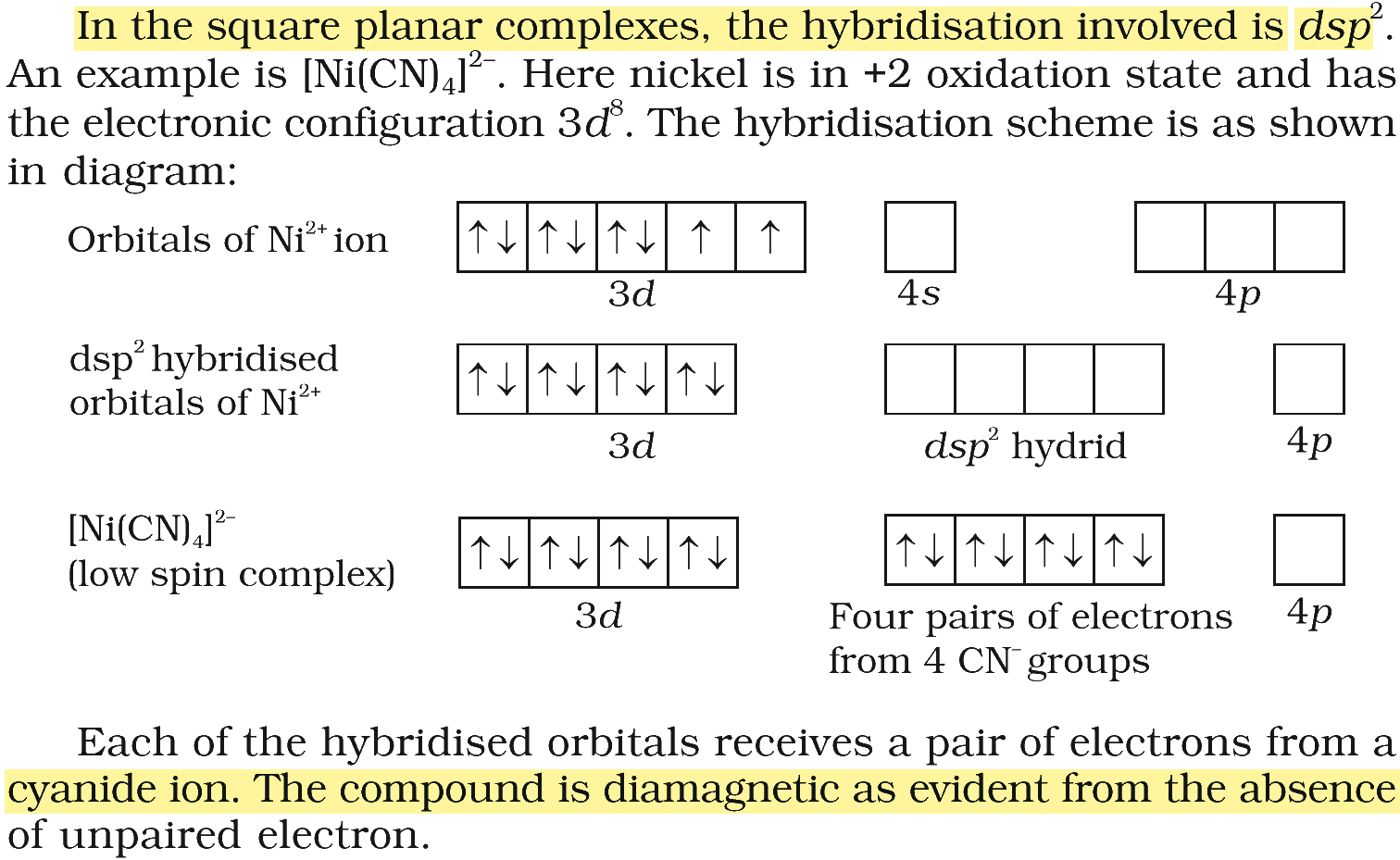
dsp2 hybridisation (uses one inner 3d orbital): square planar.
Oxidation state of Ni in \( \ce{Na2[Ni(CN)4]} \): 2(+1) + x + 4(−1) = 0, so x = +2.
Ni (Z = 28): [Ar] 3d8 4s2
\( \ce{Ni^{2+}} \): remove the two 4s electrons → [Ar] 3d8
The strong field \( \ce{CN^{-}} \) ligands pair the two single electrons, leaving one 3d orbital empty. This 3d orbital, the 4s and two 4p orbitals form dsp2 hybrids that accept the four \( \ce{CN^{-}} \) lone pairs. So \( \ce{[Ni(CN)4]^{2-}} \) is square planar, and with no unpaired electrons it is diamagnetic.
Why the other options are incorrect
Option (2) Tetrahedral & Paramagnetic — Incorrect. This describes \( \ce{[NiCl4]^{2-}} \), where the weak field \( \ce{Cl^{-}} \) does not cause pairing: sp3, two unpaired electrons.
Option (3) Square planar & Paramagnetic — Incorrect. The square planar (dsp2) arrangement is possible only after all eight d electrons are paired, so it cannot be paramagnetic here.
Option (4) Tetrahedral & Diamagnetic — Incorrect. This describes a d10 complex such as \( \ce{[Ni(CO)4]} \) (Ni in the 0 state), not a \( \ce{Ni^{2+}} \) complex.
NCERT (2026-27 edition):
Valence Bond Theory – …