Read the following passage carefully and answer the given questions.
Mendelian Disorders
Mendelian disorders are mainly determined by alteration or mutation in the single gene. These disorders are transmitted to the offspring on the same lines as we have studied in the principle of inheritance. The pattern of inheritance of such Mendelian disorders can be traced in a family by the pedigree analysis. Most common and prevalent Mendelian disorders are Haemophilia, Cystic fibrosis, Sickle cell anaemia, Colour blindness, Phenylketonuria, Thalassemia, etc. It is important to mention here that such Mendelian disorders may be dominant or recessive. By pedigree analysis one can easily understand whether the trait in question is dominant or recessive. Similarly, the trait may also be linked to the sex chromosome as in case of haemophilia. It is evident that this X-linked recessive trait shows transmission from carrier female to male progeny.
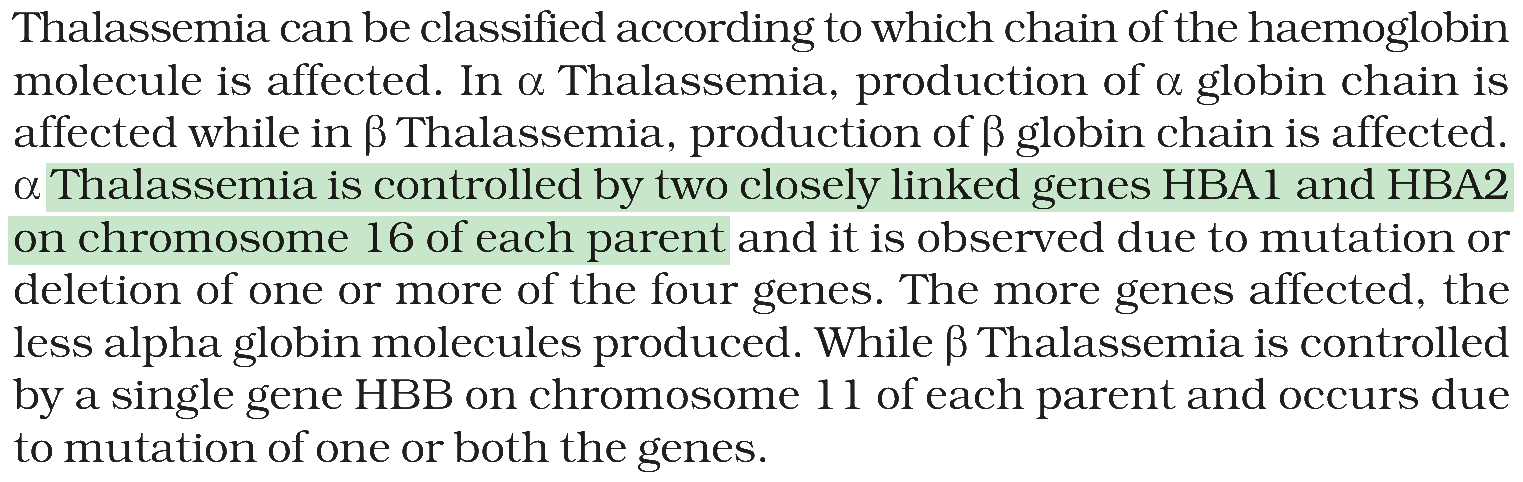
α-thalassemia is controlled by two closely linked genes HBA1 and HBA2, present on __________ of each parent.
Answer & explanation
Correct answer: option 3
The correct answer is Option (3) → Chromosome 16
Thalassemia is an autosome-linked recessive blood disease. A mutation or deletion lowers the synthesis of one of the globin chains of haemoglobin, which causes anaemia. It is of two types, named after the chain affected. α Thalassemia is controlled by two closely linked genes, HBA1 and HBA2, on chromosome 16 of each parent; the more of these four genes are affected, the less α globin is made. β Thalassemia is controlled by a single gene, HBB, on chromosome 11.
Note 1: This passage is taken from NCERT as it is. Most CUET (UG) questions come straight from NCERT, so study the book line by line, including figures and their titles.
Note 2: A similar question was also asked in CUET (UG) 2026 on 15-05-2026 (Slot 1).
NCERT Extract:
Mendelian Disorders – …