
CUETMOCK
  • Pricing
  • Mentors
Log inStart freeStart free mocks→

First test, then trust

Try a free CUET mock test.

Join 5,00,000+ students who rehearsed exam day on the exact NTA screen before sitting CUET. On the web and on Android.

Start free mocks →Get the Android app
CUETMOCK

India's #1 CUET Mock Test Platform. Original NCERT-based questions on the exact NTA exam screen — trusted by 5,00,000+ students since CUET 2022.

Get it onGoogle PlayScan to download the CUETMOCK app

Mock tests

  • CUET mock test series
  • Browse all papers
  • Commerce mocks
  • Humanities (Arts) mocks
  • Science mocks
  • Languages & GAT mocks
  • Free practice questions
  • Pricing

Resources

  • CUET exam guide
  • CUET syllabus
  • Universities accepting CUET
  • Expert blogs
  • News & notifications
  • Webinars & counselling
  • CUET score calculator
  • How we estimate your rank
  • FAQs

Company

  • About us
  • Our leadership & team
  • Our toppers
  • Mentors
  • For schools
  • Contact us
  • Terms
  • Privacy
  • Refund policy

Talk to us

+91 7696 6630 56info@cuetmock.comWhatsApp us

Our other platforms

  • JEE Mock — For IIT-JEE aspirants
  • NEET Mock — For NEET aspirants

Newsletter

Exam updates, study material and offers — no spam.

© 2026 NYC Ventures Pvt. Ltd.

701-702, Royal Business Park, Zirakpur, Punjab - 140603

  • Terms of use
  • Privacy policy
  • Refund policy
  • Contact us

iCUETMOCK is an independent preparation platform, not affiliated with the National Testing Agency (NTA). Always check exam details on the official NTA website.

  • Home
  • Mock tests
  • CUET guide
  • Pricing
  • Log in
Home/Practice questions/Biology
BiologySexual Reproduction in Flowering Plants

Identify the structures associated with a typical dicot embryo.(A) Ra…

Identify the structures associated with a typical dicot embryo.

(A) Radicle

(B) Coleoptile

(C) Tapetum

(D) Epiblast

Choose the correct answer from the options given below:

Answer & explanation+

Correct answer: option 3

The correct answer is Option (3) → (A), (B) and (D) only

Note: The given answer is as per the official NTA Answer Key. However, the question prints “dicot” where “monocot (grass)” is meant, as explained below. For a typical dicot embryo only (A) Radicle is right, and no option gives that. Option (3) fits the embryo of a grass, which is a monocot.

An embryo has an embryonal axis. In a dicot, it has two cotyledons, a plumule above and a radicle below. The embryo of a grass (a monocot) has one cotyledon, called the scutellum, and some extra parts.

(A) Radicle — Present. It is the root tip at the lower end of the embryonal axis, covered by the root cap. Both the dicot and the grass embryo have it.

(B) Coleoptile — Present in the grass embryo. It is the hollow sheath that encloses the shoot apex. The dicot embryo does not have it.

(C) Tapetum — Not a part of any embryo. It is the innermost layer of the anther wall, and it nourishes the developing pollen grains.

(D) Epiblast — Present in the grass embryo. It is labelled in the grass embryo and is not found in the dicot embryo.

NCERT Extract:
Embryo – “Embryos of monocotyledons (Figure 1.14 b) possess only one cotyledon. In the grass family the cotyledon is called scutellum that is situated towards one side (lateral) of the embryonal axis. At its lower end, the embryonal axis has the radical and root cap enclosed in an undifferentiated sheath called coleorrhiza. The portion of the embryonal axis above the level of attachment of scutellum is the epicotyl. Epicotyl has a shoot apex and a few leaf primordia enclosed in a hollow foliar structure, the coleoptile.”
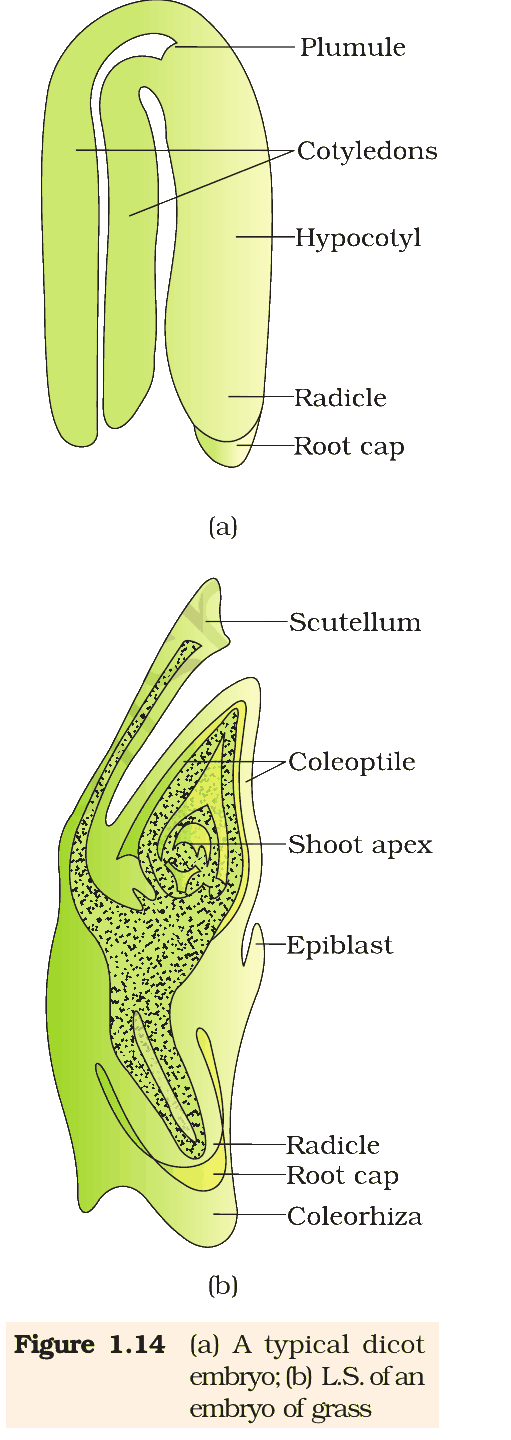
Textbook figure

Advertisement

Practise more on Sexual Reproduction in Flowering Plants

Chapter-wise mocks on the real NTA exam screen, with solutions and your rank. Your first mocks are free.

Start free mocks →

Advertisement

Next questions

  1. Arrange the following historical events in chronological order.A. Humayun takes refuge in Persia.B. Babur came to India.C. Akbar establishe…Fine Arts · The Mughal School of Miniature Painting
  2. A person has invested Rs. 20,000 in hundred-rupees bond and redeemable at the end of 10 years at 110, and paying annual dividends at 4%. Th…Applied Maths. Section B2 · Financial Mathematics
  3. The famous sufi saint Shaikh Nizamuddin Auliya is associated with which city?History · Medieval India: Bhakti Sufi Traditions
  4. Na2[Ni(CN)4] is.........Chemistry · Inorganic: Coordination Compounds
  5. When the firm is dissolved, its books of account are to be closed and the profit or loss arising on realisation of its assets and discharge…Accountancy Part A · Dissolution of Partnership Firm
  6. Prakash is achievement-oriented, dependable, responsible, hardworking and self-controlled. Prakash is high on __________ factor.Psychology · Self and Personality
  7. Identify the correct sequence of events during the menstrual cycle.(A) Proliferative phase(B) Ovulatory phase(C) Menstrual phase(D) Luteal…Biology · Human Reproduction
  8. If a×b=a×c and a≠0 , then which of the following is/are TRUE?A. b=c B. b+c=0 C. b=c+λa for some scalar λ D. b+c=λa for some scalar λ Choose…Maths. Section B1 · Vectors
  9. Consider the following and select the correct statements(A) The ratio in which the continuing partners acquire the outgoing partner's share…Accountancy Part A · Reconstitution of Partnership Firm: Retirement and Death
  10. In which year Planning Commission initiated agro-climatic planning?Geography · India-People and Economy: Land resources and Agriculture