Under which of the following exchange rate systems appreciation and depreciation take place in the exchange rate?
Answer & explanation
Correct answer: option 2
The correct answer is Option (2) → Under floating exchange rate
The exchange rate is the price of one currency in terms of another, for example the number of rupees needed to buy one dollar. Who sets this price, and so what its changes are called, depends on the system a country follows:
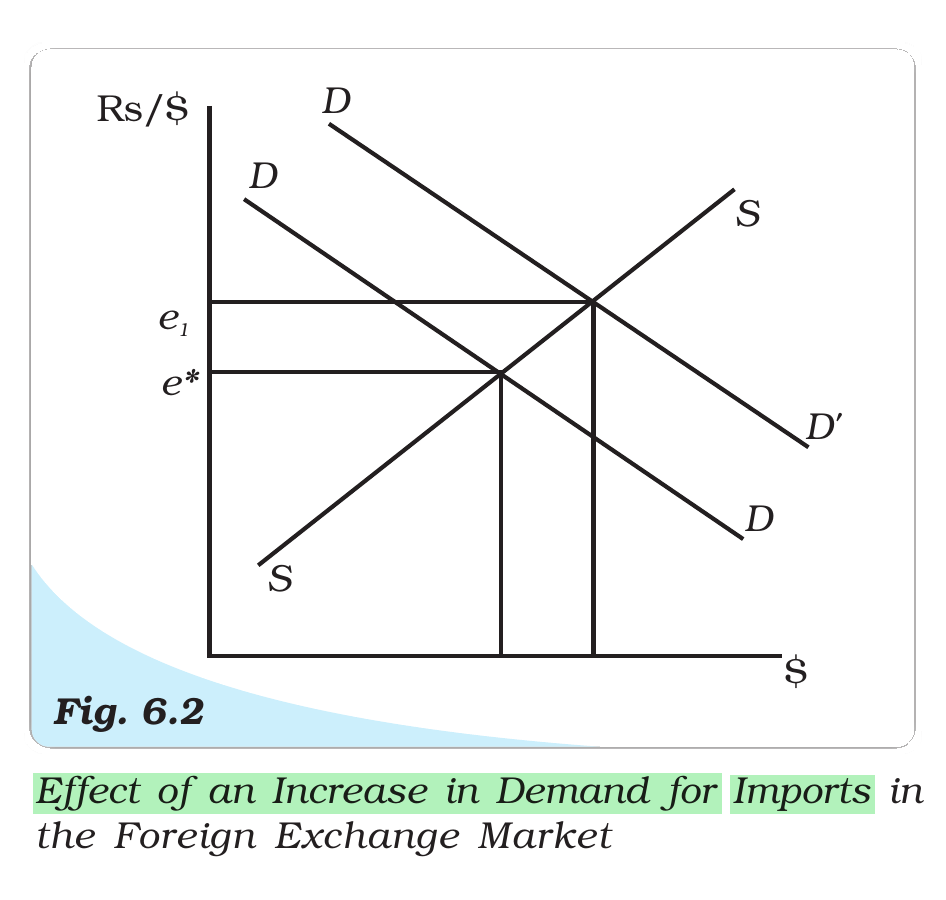
Floating (flexible) exchange rate: the rate is set by the market demand for and supply of foreign exchange, and the central bank does not step in. When the demand for dollars rises, the rupee price of a dollar rises and the rupee loses value, which is depreciation; when the supply of dollars rises, the rupee gains value, which is appreciation.
Fixed exchange rate: the government holds the rate at a chosen level. When it raises the rate, making the domestic currency cheaper, the change is called devaluation; when it lowers the rate, it is called revaluation.
Depreciation and appreciation are moves of the market, so they take place only where the market sets the rate, under a floating exchange rate.
Why the other options are incorrect
Option (1) Under fixed exchange rate — Incorrect. A fixed rate changes only by government decision, and those changes are devaluation and revaluation, not depreciation and appreciation.
Option (3) Under controlled and regulated exchange rate — Incorrect. A rate controlled and regulated by the authorities is a fixed rate, so its changes are devaluation and revaluation, made by government decision.
Option (4) Under equal exchange rate — Incorrect. There is no such exchange rate system.
Note: A same/similar question was asked in CUET (UG) in the papers below.
| 2026 | 2025 | 2024 | 2023 | 2022 |
| 11-05 S1* 21-05 S1 | – | – | – | – |
* A similar question.
NCERT (2025-26): “Flexible Exchange Rate … This exchange rate is determined by the market forces of demand and supply. It is also known as Floating Exchange Rate. As depicted in Fig. 6.1, the exchange rate is determined where the demand curve intersects with the supply curve, i.e., at point e on the Y – axis. Point q on the x – axis determines the quantity of US Dollars that have been demanded and supplied on e exchange rate. In a completely flexible system, the Central banks do not intervene in the foreign exchange market.… …Increase in exchange rate implies that the price of foreign currency (dollar) in terms of domestic currency (rupees) has increased. This is called Depreciation of domestic currency (rupees) in terms of foreign currency (dollars). Similarly, in a flexible exchange rate regime, when the price of domestic currency (rupees) in terms of foreign currency (dollars) increases, it is called Appreciation of the domestic currency (rupees) in terms of foreign currency (dollars).…”
|