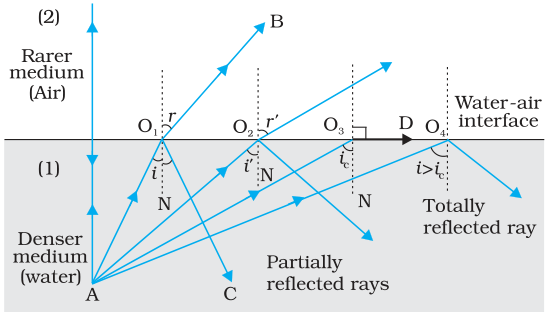
Light is incident on an interface between water (refractive index = 1.33) and glass (refractive index = 1.5). For total internal reflection, light should be traveling from
(ic is the critical angle)
Answer & explanation
Correct answer: option 2
The correct answer is Option (2) → glass to water with an angle of incidence i > ic
Total internal reflection needs light to go from the optically denser to the rarer medium at an angle greater than the critical angle. Glass (1.5) is denser than water (1.33), so light must go from glass to water:
\( \displaystyle \sin i_c = \frac{n_{\mathrm{water}}}{n_{\mathrm{glass}}} = \frac{1.33}{1.5} \approx 0.887 \)
\( \displaystyle i_c \approx 62^\circ \)
For \( i \gt i_c \) all the light is reflected back into the glass.
Why the other options are incorrect
Option (1) water to glass with an angle of incidence i > ic — Incorrect. Water to glass is rarer to denser; a refracted ray always exists.
Option (3) water to glass with an angle of incidence i < ic — Incorrect. Water to glass is the wrong direction, and \( i \lt i_c \) is the wrong condition as well.
Option (4) glass to water with an angle of incidence i < ic — Incorrect. Right direction, but for \( i \lt i_c \) the light is partly refracted into the water.
NCERT (2026-27):
Total Internal Reflection – “When light travels from an optically denser medium to a rarer medium at the interface, it is partly reflected back into the same medium and partly refracted to the second medium. This reflection is called the internal reflection. … If the angle of incidence is increased still further (e.g., the ray AO4), refraction is not possible, and the incident ray is totally reflected. This is called total internal reflection. … The angle of incidence corresponding to an angle of refraction 90°, say \( \angle \mathrm{AO_3N} \), is called the critical angle (\( i_c \)) for the given pair of media. … For values of \( i \) larger than \( i_c \), Snell’s law of refraction cannot be satisfied, and hence no refraction is possible.”