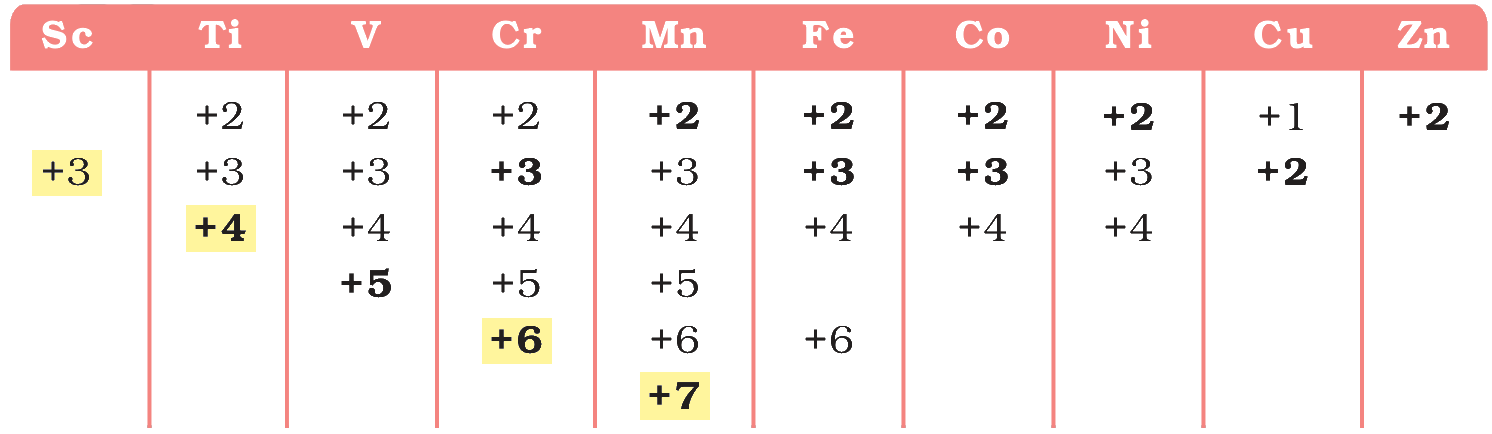
Arrange the following 3d transition metals in increasing order of their highest exhibited oxidation state:
A. Cr
B. Ti
C. Mn
D. Sc
Choose the correct answer from the options given below:
Answer & explanation
Correct answer: option 1
The correct answer is Option (1) → D, B, A, C
In the first half of the 3d series, a transition metal can use all its 4s and 3d electrons for bonding, so its highest oxidation state equals the total number of (n−1)d and ns electrons. This holds from Sc to Mn; after Mn the highest state falls again.
Working it out from each configuration:
(D) Sc (Z = 21): [Ar]3d14s2 — 1 + 2 = 3, highest state +3
(B) Ti (Z = 22): [Ar]3d24s2 — 2 + 2 = 4, highest state +4
(A) Cr (Z = 24): [Ar]3d54s1 — 5 + 1 = 6, highest state +6 (as in \( \ce{CrO4^{2-}} \), \( \ce{Cr2O7^{2-}} \))
(C) Mn (Z = 25): [Ar]3d54s2 — 5 + 2 = 7, highest state +7 (as in \( \ce{MnO4^{-}} \))
Increasing order:
\( \displaystyle +3<+4<+6<+7 \)
\( \displaystyle \mathrm{Sc}<\mathrm{Ti}<\mathrm{Cr}<\mathrm{Mn} \)
Shortcut: Options (1) and (4) both start with D (Sc) and end with C (Mn). Ti (+4) must come before Cr (+6), which gives Option (1).
NCERT (2026-27 edition):
Oxidation States – …