
CUETMOCK
  • Pricing
  • Mentors
Log inStart freeStart free mocks→

First test, then trust

Try a free CUET mock test.

Join 5,00,000+ students who rehearsed exam day on the exact NTA screen before sitting CUET. On the web and on Android.

Start free mocks →Get the Android app
CUETMOCK

India's #1 CUET Mock Test Platform. Original NCERT-based questions on the exact NTA exam screen — trusted by 5,00,000+ students since CUET 2022.

Get it onGoogle PlayScan to download the CUETMOCK app

Mock tests

  • CUET mock test series
  • Browse all papers
  • Commerce mocks
  • Humanities (Arts) mocks
  • Science mocks
  • Languages & GAT mocks
  • Free practice questions
  • Pricing

Resources

  • CUET exam guide
  • CUET syllabus
  • Universities accepting CUET
  • Expert blogs
  • News & notifications
  • Webinars & counselling
  • CUET score calculator
  • How we estimate your rank
  • FAQs

Company

  • About us
  • Our leadership & team
  • Our toppers
  • Mentors
  • For schools
  • Contact us
  • Terms
  • Privacy
  • Refund policy

Talk to us

+91 7696 6630 56info@cuetmock.comWhatsApp us

Our other platforms

  • JEE Mock — For IIT-JEE aspirants
  • NEET Mock — For NEET aspirants

Newsletter

Exam updates, study material and offers — no spam.

© 2026 NYC Ventures Pvt. Ltd.

701-702, Royal Business Park, Zirakpur, Punjab - 140603

  • Terms of use
  • Privacy policy
  • Refund policy
  • Contact us

iCUETMOCK is an independent preparation platform, not affiliated with the National Testing Agency (NTA). Always check exam details on the official NTA website.

  • Home
  • Mock tests
  • CUET guide
  • Pricing
  • Log in
Home/Practice questions/Chemistry
ChemistryOrganic: Aldehydes, Ketones and Carboxylic Acids

The aldehyde group is converted into carboxylic acid in the presence…

The aldehyde group is converted into carboxylic acid in the presence of

(A) aqueous copper sulfate and alkaline sodium potassium tartrate.

(B) Freshly prepared ammoniacal silver nitrate solution.

(C) Lithium aluminium hydride.

(D) H2 and Palladium on barium sulphate.

Choose the correct answer from the options given below:

Answer & explanation+

Correct answer: option 1

The correct answer is Option (1) → (A) and (B) only

Converting an aldehyde group (–CHO) into a carboxylic acid group (–COOH) is an oxidation. Aldehydes are easily oxidised, even by mild oxidising agents, because the carbonyl carbon carries a hydrogen atom. Reducing agents move the other way and give alcohols or stop at aldehydes.

  • (A) aqueous copper sulfate and alkaline sodium potassium tartrate. — Correct. This is Fehling’s reagent. The aldehyde is oxidised to the carboxylate ion and a red-brown precipitate of \( \ce{Cu2O} \) forms.

        \( \displaystyle \ce{RCHO + 2Cu^2+ + 5OH^- -> RCOO^- + Cu2O v + 3H2O} \)

  • (B) Freshly prepared ammoniacal silver nitrate solution. — Correct. This is Tollens’ reagent. The aldehyde is oxidised to the carboxylate ion and silver is deposited as a bright silver mirror.

        \( \displaystyle \ce{RCHO + 2[Ag(NH3)2]^+ + 3OH^- -> RCOO^- + 2Ag + 2H2O + 4NH3} \)

  • (C) Lithium aluminium hydride. — Incorrect. \( \ce{LiAlH4} \) is a reducing agent. It reduces an aldehyde to a primary alcohol.

        \( \displaystyle \ce{RCHO} \xrightarrow[\text{(ii) }\ce{H2O}]{\text{(i) }\ce{LiAlH4}} \ce{RCH2OH} \)

  • (D) H2 and Palladium on barium sulphate. — Incorrect. This is the Rosenmund catalyst, which reduces acyl chlorides to aldehydes. Hydrogen cannot oxidise an aldehyde.

        \( \displaystyle \ce{RCOCl + H2} \xrightarrow{\ce{Pd-BaSO4}} \ce{RCHO + HCl} \)

In both tests the acid is present as its anion because the reagent is alkaline; acidifying the mixture gives the free carboxylic acid.

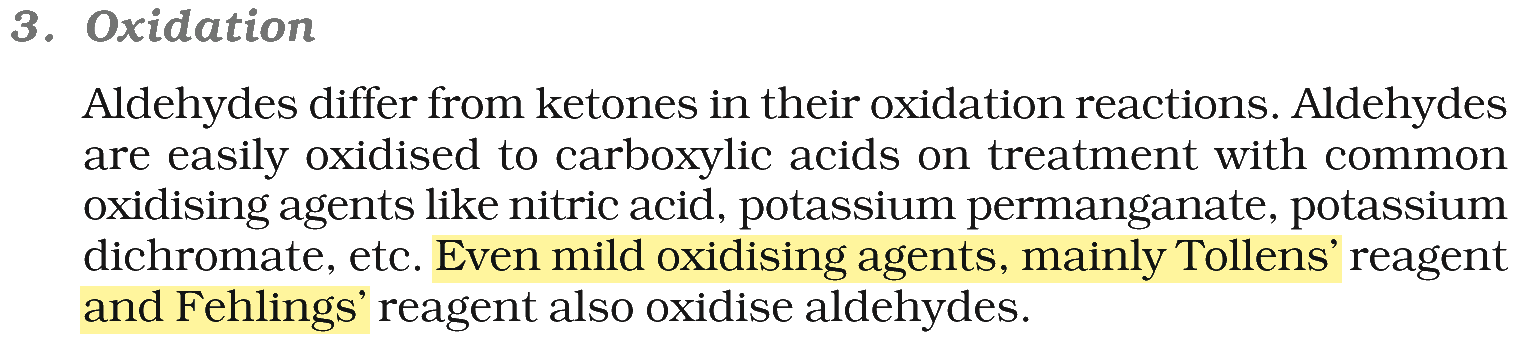
NCERT (2026-27 edition):
Oxidation – …
Textbook extract

Reduction – “… (i) Reduction to alcohols: Aldehydes and ketones are reduced to primary and secondary alcohols respectively by sodium borohydride (NaBH4) or lithium aluminium hydride (LiAlH4) as well as by catalytic hydrogenation (Unit 7, Class XII).”

Preparation of Aldehydes – “… Acyl chloride (acid chloride) is hydrogenated over catalyst, palladium on barium sulphate. This reaction is called Rosenmund reduction.”

Advertisement

Practise more on Organic: Aldehydes, Ketones and Carboxylic Acids

Chapter-wise mocks on the real NTA exam screen, with solutions and your rank. Your first mocks are free.

Start free mocks →

Advertisement

Next questions

  1. A typical embryo sac in angiosperms is:Biology · Sexual Reproduction in Flowering Plants
  2. Divergent evolution refers to:Biology · Evolution
  3. Match List-I with List-IIList-IList-IIRecent extinct speciesAssociated countries(A) Quagga(I) Australia(B) Dodo(II) Africa(C) Thylacine(III…Biology · Biodiversity and Conservation
  4. Which of the following will give Cannizzaro reaction?Chemistry · Organic: Aldehydes, Ketones and Carboxylic Acids
  5. Which one of the following is associated with the idea of planning that gained a good deal of public support in the 1940s and 1950s?Political Science · Politics in India Since Independence: Politics of Planned Development
  6. Which of the following differential equations has y=x as one of its particular solution?Applied Maths. Section A · Differential Equations (Section A)
  7. If [bullet] denotes the greatest integer function, then the values of ∫_0^1.6 [x^2]dx is:Maths. Section B1 · Definite Integration
  8. The above experiment proves that DNA replication is:Biology · Molecular Basis of Inheritance
  9. What kind of impression Rashmi had with her existing team working as District Sales Manager?Business Studies · Directing
  10. Kapil, Rahul and Virat are partners in a firm sharing profits in the ratio of 3:2:1. They decide to share future profits equally w.e.f Apri…Accountancy Part A · Admission of a Partner