Carboxylic Acids: Types of Reactions
Carboxylic acid exhibits a number of reactions depending on the involvement of a specific part of the -COOH group. It mainly includes nucleophilic acyl substitution reaction, in which a hydroxy group of -COOH is replaced by another nucleophile, and the acidic behavior of carboxylic acids, which is due to the cleavage of O-H bond in -COOH group. The former reaction leads to the conversion of carboxylic acid into a variety of different derivatives/categories of organic compounds, whereas the latter converts it into salts which find applications in many industries, like soap and detergent synthesis and pharmaceutical industries. Other important types of chemical reactions involve reduction of -COOH group, decarboxylation, electrolysis and substitution reactions in the hydrocarbon part at α-carbon atom.
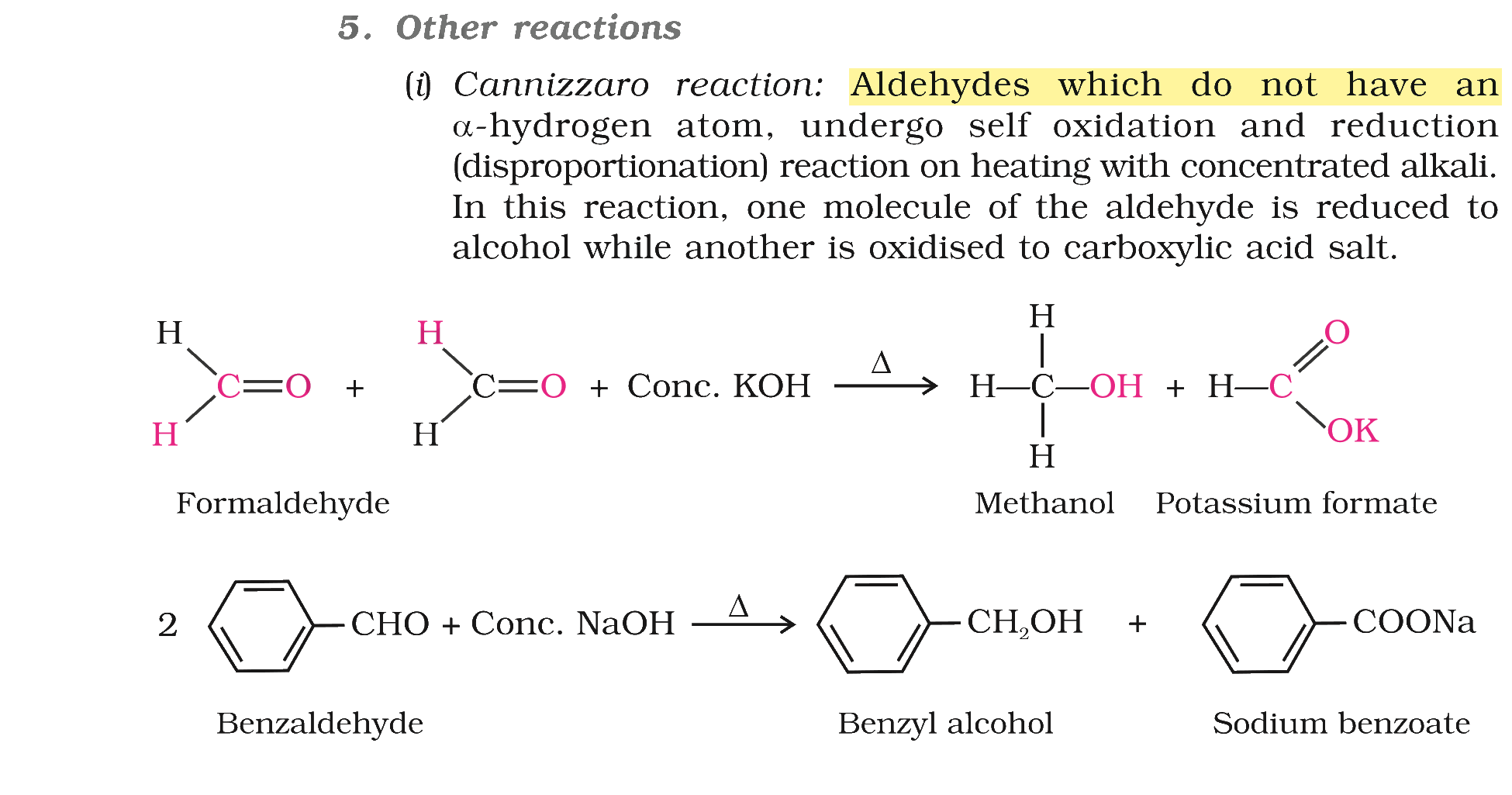
Which of the following will give Cannizzaro reaction?
Answer & explanation
Correct answer: option 1
The correct answer is Option (1) → HCHO
The Cannizzaro reaction is given by aldehydes that have no α-hydrogen atom. When heated with concentrated alkali, two molecules undergo self oxidation-reduction (disproportionation). One molecule is reduced to an alcohol, and the other is oxidised to the salt of a carboxylic acid:
\( \displaystyle \ce{2HCHO + KOH} \xrightarrow{\text{conc., heat}} \ce{CH3OH + HCOOK} \)
Aldehydes and ketones that do have α-hydrogens react with dilute alkali by aldol condensation instead.
Methanal (HCHO) has no α-carbon at all, so it has no α-hydrogen and gives the Cannizzaro reaction.
Why the other options are incorrect
Option (2) CH3CH2OH — Incorrect. Ethanol is an alcohol. It has no carbonyl group, so it cannot undergo either Cannizzaro or aldol reactions.
Option (3) CH3COCH3 — Incorrect. Propanone is a ketone with six α-hydrogens, so it undergoes aldol condensation instead.
Option (4) CH3CH2CHO — Incorrect. Propanal has two α-hydrogens, so it undergoes aldol condensation instead.
NCERT (2026-27 edition):
Other Reactions