
Which of the following products is not possible by the reaction of corresponding sodium alkoxide with methyl chloride in Williamson’s synthesis?
Answer & explanation
Correct answer: option 1
The correct answer is Option (1) → Phenetole
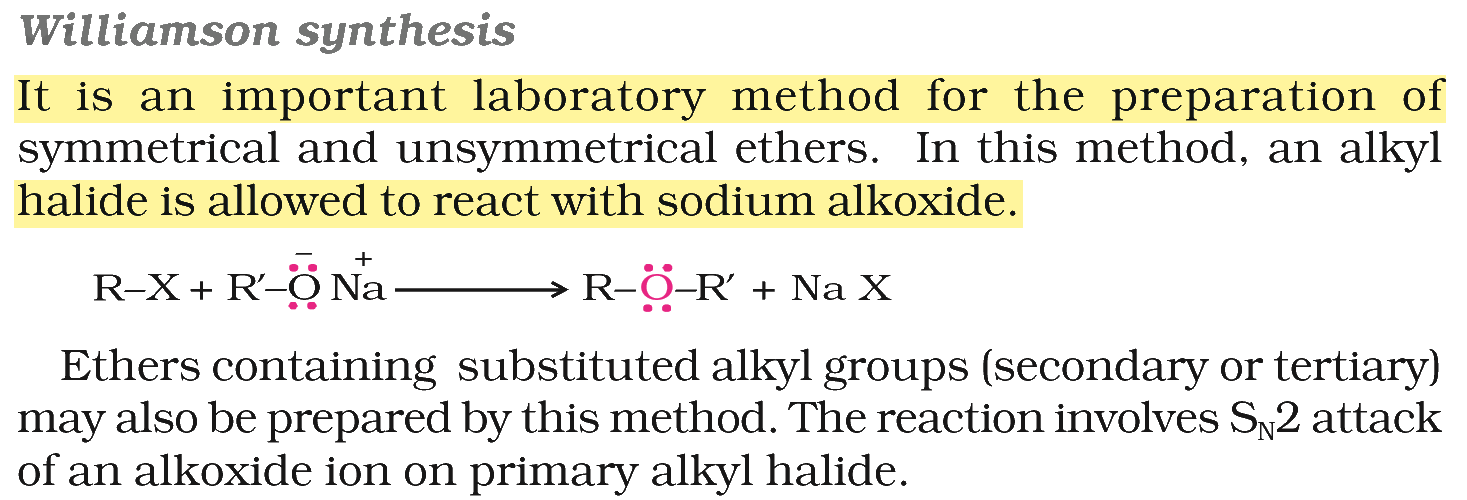
In the Williamson synthesis, an alkyl halide reacts with a sodium alkoxide (or phenoxide). The alkoxide ion attacks the alkyl halide by an SN2 reaction, and the alkyl group of the halide becomes one of the two groups of the ether:
\( \displaystyle \ce{R-X + R1-O^-Na^+ -> R1-O-R + NaX} \)
With methyl chloride as the halide, the product is always a methyl ether, \( \ce{R1-O-CH3} \):
\( \displaystyle \ce{CH3-Cl + R1-O^-Na^+ -> R1-O-CH3 + NaCl} \)
Option (1) Phenetole — Not possible with methyl chloride. Phenetole is ethoxybenzene, \( \ce{C6H5-O-C2H5} \); it has no –OCH3 group, so it cannot be formed from methyl chloride with any alkoxide. It is made from sodium phenoxide and an ethyl halide:
\( \displaystyle \ce{C6H5-O^-Na^+ + C2H5-Br -> C6H5-O-C2H5 + NaBr} \)
Option (2) t-butyl methyl ether — Possible from the sodium alkoxide and methyl chloride. Sodium tert-butoxide reacts with methyl chloride:
\( \displaystyle \ce{(CH3)3C-O^-Na^+ + CH3-Cl -> (CH3)3C-O-CH3 + NaCl} \)
Option (3) Ethyl methyl ether — Possible from the sodium alkoxide and methyl chloride. Sodium ethoxide reacts with methyl chloride:
\( \displaystyle \ce{C2H5-O^-Na^+ + CH3-Cl -> C2H5-O-CH3 + NaCl} \)
Option (4) n-propyl methyl ether — Possible from the sodium alkoxide and methyl chloride. Sodium propoxide reacts with methyl chloride:
\( \displaystyle \ce{CH3CH2CH2-O^-Na^+ + CH3-Cl -> CH3CH2CH2-O-CH3 + NaCl} \)
NCERT (2026-27 edition):
Preparation of Ethers – …
“… Phenols are also converted to ethers by this method. In this, phenol is used as the phenoxide moiety.”