
Arrange the following compounds in increasing order of their reactivity towards nucleophilic addition reaction.
(A) Ethanal
(B) Propanal
(C) Propanone
(D) Butanone
Choose the correct answer from the options given below:
Answer & explanation
Correct answer: option 1
The correct answer is Option (1) → (D), (C), (B), (A)
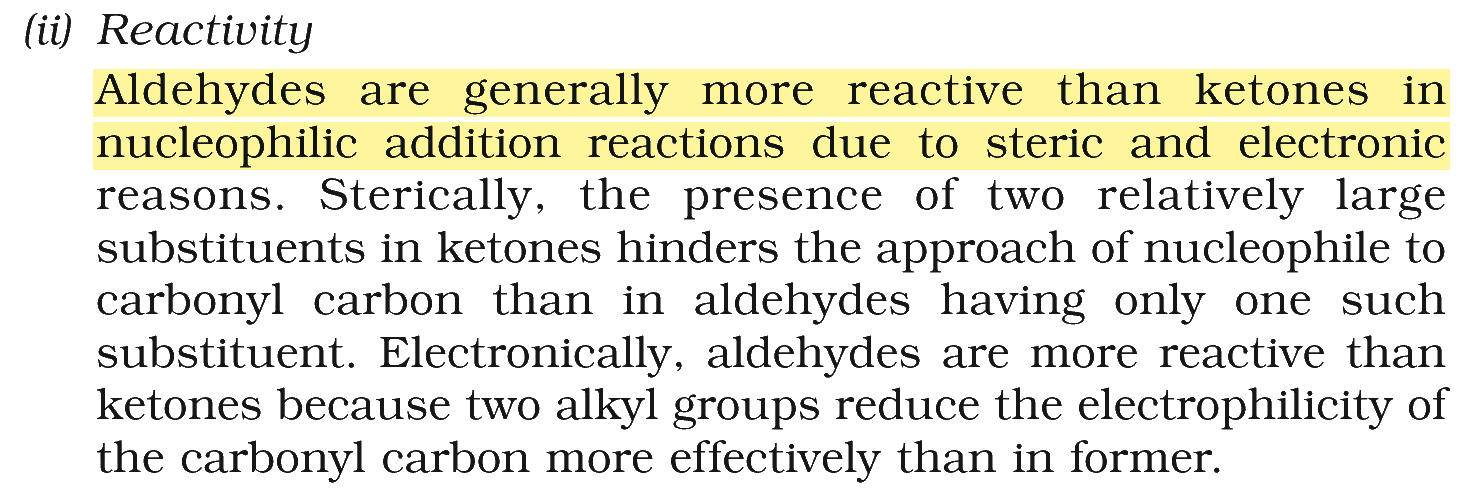
Alkyl groups lower the reactivity of the C=O carbon towards nucleophiles by both an electronic (+I) and a steric effect: they reduce the positive charge on the carbonyl carbon and crowd the approach of the nucleophile.
Both factors act in the same direction, so aldehydes are more reactive than ketones, and within each class the compound with smaller alkyl groups is more reactive:
\( \displaystyle \text{ketone (larger groups)} < \text{ketone} < \text{aldehyde (larger group)} < \text{aldehyde} \)
\( \displaystyle \ce{CH3COCH2CH3} < \ce{CH3COCH3} < \ce{CH3CH2CHO} < \ce{CH3CHO} \)
Matching the given compounds:
(D) Butanone: \( \ce{CH3COCH2CH3} \) (ketone, \( \ce{CH3} \) and \( \ce{C2H5} \))
(C) Propanone: \( \ce{CH3COCH3} \) (ketone, two \( \ce{CH3} \))
(B) Propanal: \( \ce{CH3CH2CHO} \) (aldehyde, \( \ce{C2H5} \))
(A) Ethanal: \( \ce{CH3CHO} \) (aldehyde, \( \ce{CH3} \))
Shortcut: Butanone (D) is the least reactive and ethanal (A) the most reactive. Only Option (1) starts with (D) and ends with (A).
NCERT (2026-27 edition):
Reactivity
Note: The same/similar question has been asked in different years by NTA as per the details given below:
| 2026 | 2025 | 2024 | 2023 | 2022 |
|---|---|---|---|---|
| 07-06 S2 26-05 S2 22-05 S1 | 24-05 S2 13-05 S1 | – | – | – |