Suppose the consumption function is given as Y = a + bX, identify the option that is not associated with this function.
Answer & explanation
Correct answer: option 2
The correct answer is Option (2) → A and B are variables.
Y = a + bX is the equation of a straight line. X and Y can take many values and move together, so they are the variables; a and b stay fixed for a given line, so they are constants. The constant a is the intercept on the Y axis, the value of Y when X is zero, and b is the slope of the line.
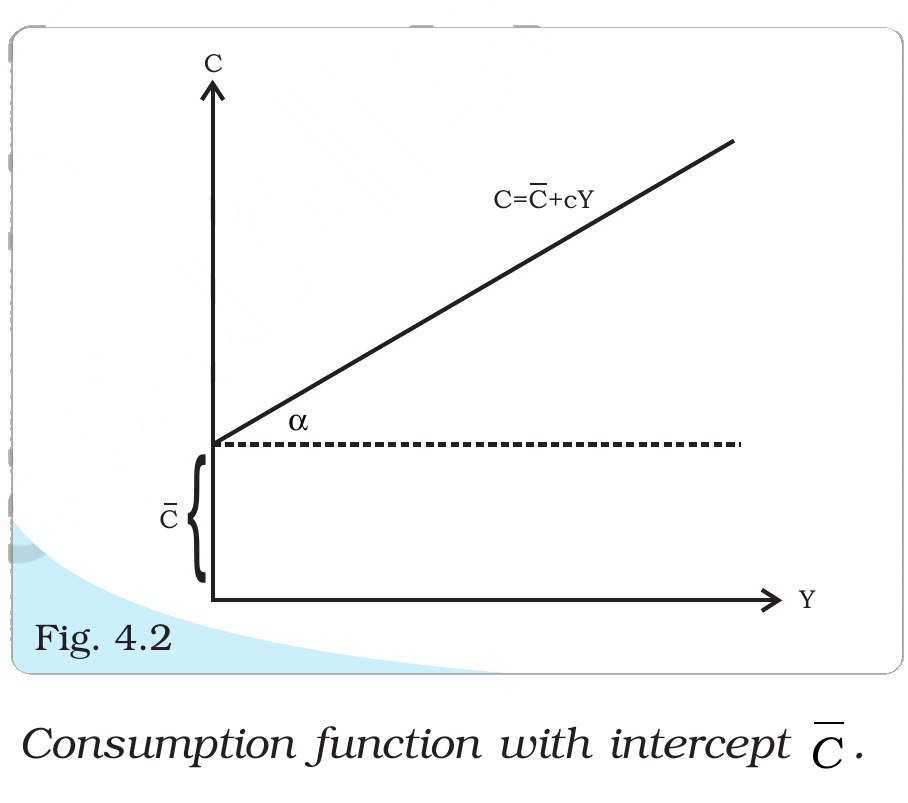
The consumption function C = C̄ + cY has the same form, with autonomous consumption C̄ as the intercept and the marginal propensity to consume c as the slope.
Option (1) X and Y are variables with a linear relationship between them. — Associated with the function. X and Y are the two variables, and the equation is that of a straight line.
Option (2) A and B are variables. — Not associated with the function. a and b are constants, not variables; they fix the position and the slope of the line.
Option (3) ‘a’ is shown as the intercept. — Associated with the function. The constant a is the intercept on the Y axis.
Option (4) b is the slope of the line. — Associated with the function. The constant b is the slope of the line, the change in Y for a unit change in X.
NCERT (2025-26): “4.3.1 Macroeconomic Equilibrium with Price Level Fixed … How can this relation be shown as a graph? To answer this question we will need to recall the ‘intercept form of the linear equation’, Y = a + bX Here, the variables are X and Y and there is a linear relation between them. a and b are constants. This equation is depicted in figure 4.1. The constant ‘a’ is shown as the ‘intercept’ on the Y axis, i.e, the value of Y when X is zero. The constant ‘b’ is the slope of the line i.e. tangent θ = b. Consumption Function – Graphical Representation Using the same logic, the consumption function can be shown as follows: Consumption function, C = C̄ + cY where, C̄ = intercept of the consumption function c = slope of consumption function = tan θ…”
|