Transition elements (d-block)
Read the following passage and answer the questions given:
The d-block occupies the large middle section of the periodic table flanked between s- and p-blocks in the modern periodic table. These elements have a general electronic configuration (n-1)d1-10 ns2 (except Pd). These elements possess a partially filled penultimate d-subshell in their ground state. Most of the transition element compounds are colored in solid or in solution state which arise due to excitation of electrons from lower energy d-orbitals to higher energy d-orbitals. The transition metal ions which have completely filled d-orbitals are colorless due to lack of excitation within d-orbitals. Most of the transition metals and their compounds exhibit paramagnetic behavior (attracted by a magnetic field) which is attributed to an incomplete d-subshell and the presence of unpaired electrons. An element or ion having no unpaired electron shows diamagnetic behavior (repelled by a magnetic field). The magnetic moment of transition elements arises due to spin and orbital motion in ions or molecules. The magnetic moment is determined by the number of unpaired electrons (n) and is calculated by using the spin-only formula μ= [n (n+2)]1/2 Bohr magneton (BM). The magnetic moment increases with the increasing number of unpaired electrons. Thus, the observed magnetic moment gives a useful indication about the number of unpaired electrons present in the transition metal or its ions. Transition elements exhibit certain important characteristic properties such as variable oxidation state, complex formation, colored ion formation, catalytic activity and metallic properties like high tensile strength, ductility, malleability etc. Transition metals are hard and have high melting points (with exceptions of Zn, Cd, Hg).
Which element does not satisfy the characteristics of transition metals?
Answer & explanation
Correct answer: option 2
The correct answer is Option (2) → Zn
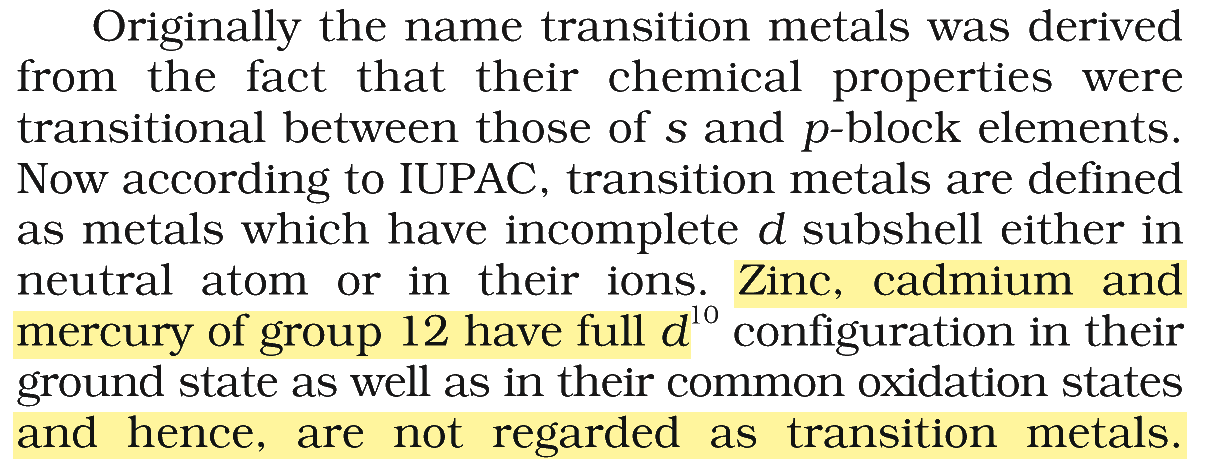
A transition element is one that has an incompletely filled d subshell either in its ground state atom or in one of its common oxidation states. The typical transition metal properties (variable oxidation states, coloured and paramagnetic ions, catalytic activity, hardness and high melting points) all come from this partly filled d subshell.
Zinc (Z = 30) is [Ar] 3d104s2; losing the two 4s electrons gives its only common ion, \( \ce{Zn^{2+}} \), which is 3d10. Its d subshell is full in both, so it fails the definition. It also lacks the typical properties: it shows only the +2 state, its compounds are white and diamagnetic, and it is a soft metal with a low melting point. So Zn does not satisfy the characteristics of transition metals.
Option (1) Sc — Satisfies the characteristics of transition metals. Sc (Z = 21) is [Ar]3d14s2, with a partly filled d subshell, so it is a transition element even though it shows only +3.
Option (2) Zn — Does not satisfy the characteristics of transition metals. Its d subshell is full in the atom and in Zn2+.
Option (3) Cr — Satisfies the characteristics of transition metals. Cr (Z = 24) is [Ar]3d54s1 and shows the typical properties, such as +2, +3 and +6 states and coloured compounds.
Option (4) Mn — Satisfies the characteristics of transition metals. Mn (Z = 25) is [Ar]3d54s2 and shows the widest range of oxidation states in the series.
Note: It seems that there is a mistake in the original NTA paper. The passage gives the general electronic configuration of the d-block elements as (n−1)d1–10 ns2 (except Pd). The correct general configuration is (n−1)d1–10 ns1–2, because some elements have only one ns electron, such as Cr (3d54s1) and Cu (3d104s1), and Pd (4d105s0) has none.
NCERT (2026-27 edition):
The d- and f-Block Elements – …