CUETMOCK
  • Pricing
  • Mentors
Log inStart freeStart free mocks→

First test, then trust

Try a free CUET mock test.

Join 5,00,000+ students who rehearsed exam day on the exact NTA screen before sitting CUET. On the web and on Android.

Start free mocks →Get the Android app
CUETMOCK

India's #1 CUET Mock Test Platform. Original NCERT-based questions on the exact NTA exam screen — trusted by 5,00,000+ students since CUET 2022.

Get it onGoogle PlayScan to download the CUETMOCK app

Mock tests

  • CUET mock test series
  • Commerce mocks
  • Humanities (Arts) mocks
  • Science mocks
  • Languages & GAT mocks
  • Free practice questions
  • Pricing

Resources

  • CUET exam guide
  • CUET syllabus
  • Universities accepting CUET
  • Expert blogs
  • News & notifications
  • Webinars & counselling
  • CUET score calculator
  • How we estimate your rank
  • FAQs

Company

  • About us
  • Our leadership & team
  • Our toppers
  • Mentors
  • For schools
  • Contact us
  • Terms
  • Privacy
  • Refund policy

Talk to us

+91 7696 6630 56info@cuetmock.comWhatsApp us

Our other platforms

  • JEE Mock — For IIT-JEE aspirants
  • NEET Mock — For NEET aspirants

Newsletter

Exam updates, study material and offers — no spam.

© 2026 NYC Ventures Pvt. Ltd.

701-702, Royal Business Park, Zirakpur, Punjab - 140603

  • Terms of use
  • Privacy policy
  • Refund policy
  • Contact us

iCUETMOCK is an independent preparation platform, not affiliated with the National Testing Agency (NTA). Always check exam details on the official NTA website.

  • Home
  • Mock tests
  • CUET guide
  • Pricing
  • Log in
Home/Practice questions/History
HistoryMedieval India: Peasants, Zamindars and the State

Identify the correct statements from below:A. Batai was also called ‘…

Identify the correct statements from below:

A. Batai was also called ‘Bhaoli’.

B. Khet-batai referred to the division of fields after they were sown.

C. The amil-guzar was responsible for the waging of wars.

D. Lang-batai referred to the division of crops after the harvest.

Choose the correct answer from the options given below:

Answer & explanation+

Correct answer: option 1

The correct answer is Option (1) → A, B and D only

The Ain-i Akbari lists the ways in which land revenue could be taken in kind, as a share of the crop.

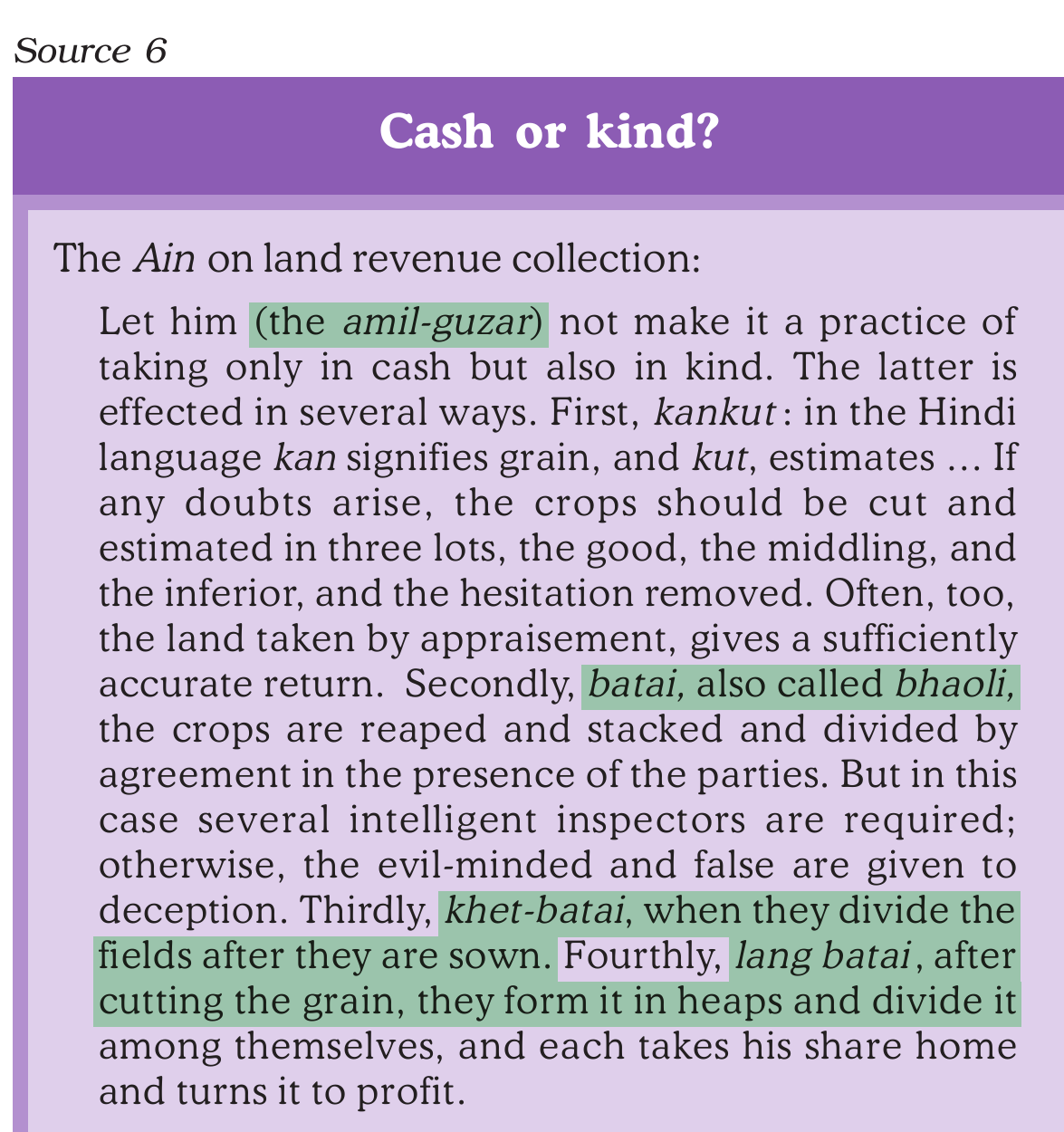
A. Batai was also called ‘Bhaoli’. Correct. In batai, also called bhaoli, the crops were reaped and stacked, then divided by agreement in the presence of both parties.

B. Khet-batai referred to the division of fields after they were sown. Correct. In khet-batai, the fields themselves were divided after they were sown.

C. The amil-guzar was responsible for the waging of wars. Incorrect. The amil-guzar was the revenue collector, not a military officer. Akbar told him to try to collect revenue in cash, while keeping the option of payment in kind open.

D. Lang-batai referred to the division of crops after the harvest. Correct. In lang batai, after the grain was cut, it was formed into heaps and divided, and each party took his share home.


NCERT (2025-26): “…In his list of duties of the amil-guzar or revenue collector, Akbar decreed that while he should strive to make cultivators pay in cash, the option of payment in kind was also to be kept open.…”

NCERT extract

Advertisement

Practise more on Medieval India: Peasants, Zamindars and the State

Chapter-wise mocks on the real NTA exam screen, with solutions and your rank. Your first mocks are free.

Start free mocks →

Advertisement

Next questions

  1. Match List-I with List-IIList-IList-IIPhysical QuantityUnit(A)Planck’s constant(I) mathrmkg m^2 s^-3 (B)Stopping potential(II) mathrmkg m^2…Physics · Dual Nature of Radiation and Matter
  2. Consider the following statements about Kyoto Protocol which was held in Japan in December 1997?(A) Involved pledges and commitments from d…General Aptitude Test · General Knowledge
  3. In late eighteenth-century revenue records, the hill folks living around Rajmahal hills were known as ____________.History · Modern India: Colonialism and the Countryside
  4. The sculpture of ‘a woman water-carrier’ from third-century CE is found at which location?History · Ancient India: Thinkers, Beliefs and Buildings
  5. Which of the following structures represents DDT?Chemistry · Organic: Haloalkanes and Haloarenes
  6. An electric dipole of moment 3×10^-9 C m in a uniform electric field experiences a maximum torque of 12×10^-4 N m. The magnitude of the ele…Physics · Electric Charges and Fields
  7. Explants are grown using special nutrient media in tissue culture techniques. The correct source of carbon in this nutrient medium is:Biology · Biotechnology and its Applications
  8. Match List I with List IIList IList IIA. Debt Equity RatioI. Primarily indicates the rate of external funds in financing assets.B. Total as…Accountancy Part B · Accounting Ratios
  9. For the functions f(x)=x^2 and g(x)=x^3 , which of the following statements are TRUE?[ where N is the set of natural numbers and Z is the s…Maths. Section B1 · Relations and Functions
  10. Which of the following country has followed the classical development pattern of gradual shift from agriculture to manufacturing and then t…Economics · Indian Economic Development: Comparative Development Experiences of India and its Neighbours