Which of the following structures represents DDT?
Answer & explanation
Correct answer: option 3
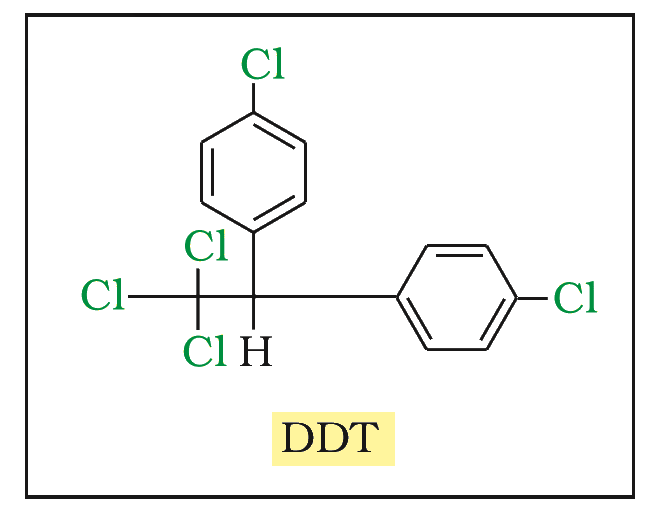
The correct answer is Option (3) → CCl3–CH(C6H4Cl)2 (structure 3)
DDT stands for p,p′-dichlorodiphenyltrichloroethane. Reading the name part by part gives the structure:
trichloroethane: a two-carbon chain with a CCl3 group at one end;
diphenyl: two benzene rings on the other carbon of the chain, which also keeps one hydrogen;
p,p′-dichloro: one chlorine at the para position of each ring.
\( \displaystyle \ce{Cl3C-CH(C6H4Cl)2} \quad \text{(1,1,1-trichloro-2,2-bis(4-chlorophenyl)ethane)} \)
Structure 3 has these features: \( \ce{CCl3} \) at one end, and a CH carrying two p-chlorophenyl rings. So structure 3 represents DDT.
Why the other options are incorrect
Option (1) structure 1 — Incorrect. Only one ring carries a p-chlorine; the other ring is a plain phenyl group.
Option (2) structure 2 — Incorrect. The carbon holding the two rings carries a chlorine instead of the hydrogen.
Option (4) structure 4 — Incorrect. The end carbon is \( \ce{CHCl2} \) (not \( \ce{CCl3} \)) and the ring-bearing carbon carries a chlorine instead of hydrogen.
NCERT (2026-27 edition):
p,p′-Dichlorodiphenyltrichloroethane (DDT)