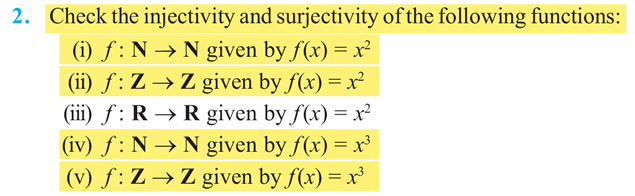
For the functions \( f(x)=x^2 \) and \( g(x)=x^3 \), which of the following statements are TRUE?
[ where \( N \) is the set of natural numbers and \( Z \) is the set of integers ]
(A) \( f:N\to N \) is one-one but not onto.
(B) \( f:Z\to Z \) is neither one-one nor onto.
(C) \( g:N\to N \) is one-one but not onto.
(D) \( g:Z\to Z \) is one-one but not onto.
Choose the correct answer from the options given below:
Answer & explanation
Correct answer: option 1
The correct answer is Option (1) → (A), (B), (C) and (D)
For \( f(x)=x^2 \): on N, \( m^2=n^2 \) gives m = n, so f is one-one; on Z, f(−1) = f(1) = 1, so f is not one-one. The value 2 is not the square of any integer, so f is not onto on N or on Z.
For \( g(x)=x^3 \): \( m^3=n^3 \) gives m = n for all integers, since the cube keeps the sign, so g is one-one on N and on Z. The value 2 is not the cube of any integer, so g is not onto on N or on Z.
So f is one-one on N but not on Z, g is one-one on both N and Z, and none of the four functions is onto (2 is never an output).
Checking the statements
(A) \( f:N\to N \) is one-one but not onto. — Correct. \( m^2=n^2 \) gives m = n in N, and 2 is not a square.
(B) \( f:Z\to Z \) is neither one-one nor onto. — Correct. f(−1) = f(1), and 2 is not a square.
(C) \( g:N\to N \) is one-one but not onto. — Correct. Different natural numbers have different cubes, and 2 is not a cube.
(D) \( g:Z\to Z \) is one-one but not onto. — Correct. The cube keeps the sign, so \( m^3=n^3 \) gives m = n, and 2 is not a cube.
NCERT (2026-27 edition):
Types of Functions