CUETMOCK
  • Pricing
  • Mentors
Log inStart freeStart free mocks→

First test, then trust

Try a free CUET mock test.

Join 5,00,000+ students who rehearsed exam day on the exact NTA screen before sitting CUET. On the web and on Android.

Start free mocks →Get the Android app
CUETMOCK

India's #1 CUET Mock Test Platform. Original NCERT-based questions on the exact NTA exam screen — trusted by 5,00,000+ students since CUET 2022.

Get it onGoogle PlayScan to download the CUETMOCK app

Mock tests

  • CUET mock test series
  • Browse all papers
  • Commerce mocks
  • Humanities (Arts) mocks
  • Science mocks
  • Languages & GAT mocks
  • Free practice questions
  • Pricing

Resources

  • CUET exam guide
  • CUET syllabus
  • Universities accepting CUET
  • Expert blogs
  • News & notifications
  • Webinars & counselling
  • CUET score calculator
  • How we estimate your rank
  • FAQs

Company

  • About us
  • Our leadership & team
  • Our toppers
  • Mentors
  • For schools
  • Contact us
  • Terms
  • Privacy
  • Refund policy

Talk to us

+91 7696 6630 56info@cuetmock.comWhatsApp us

Our other platforms

  • JEE Mock — For IIT-JEE aspirants
  • NEET Mock — For NEET aspirants

Newsletter

Exam updates, study material and offers — no spam.

© 2026 NYC Ventures Pvt. Ltd.

701-702, Royal Business Park, Zirakpur, Punjab - 140603

  • Terms of use
  • Privacy policy
  • Refund policy
  • Contact us

iCUETMOCK is an independent preparation platform, not affiliated with the National Testing Agency (NTA). Always check exam details on the official NTA website.

  • Home
  • Mock tests
  • CUET guide
  • Pricing
  • Log in
Home/Practice questions/History
HistoryAncient India: Kings, Farmers and Towns

Identify the incorrect statement in regards to the ‘inscriptions’:

Identify the incorrect statement in regards to the ‘inscriptions’:

Answer & explanation+

Correct answer: option 4

The correct answer is Option (4) → The earliest inscriptions were in Sanskrit

Option (1) Inscriptions are writings engraved on hard surfaces such as stone, metal or pottery — A correct statement (not the answer). This is the definition of an inscription. Inscriptions usually record the achievements or ideas of those who had them made, such as the deeds of kings or gifts to religious institutions.

Option (2) Inscriptions are virtually permanent records, some of which carry dates — A correct statement (not the answer). Being cut into stone or metal, inscriptions are virtually permanent records, and some carry their own dates.

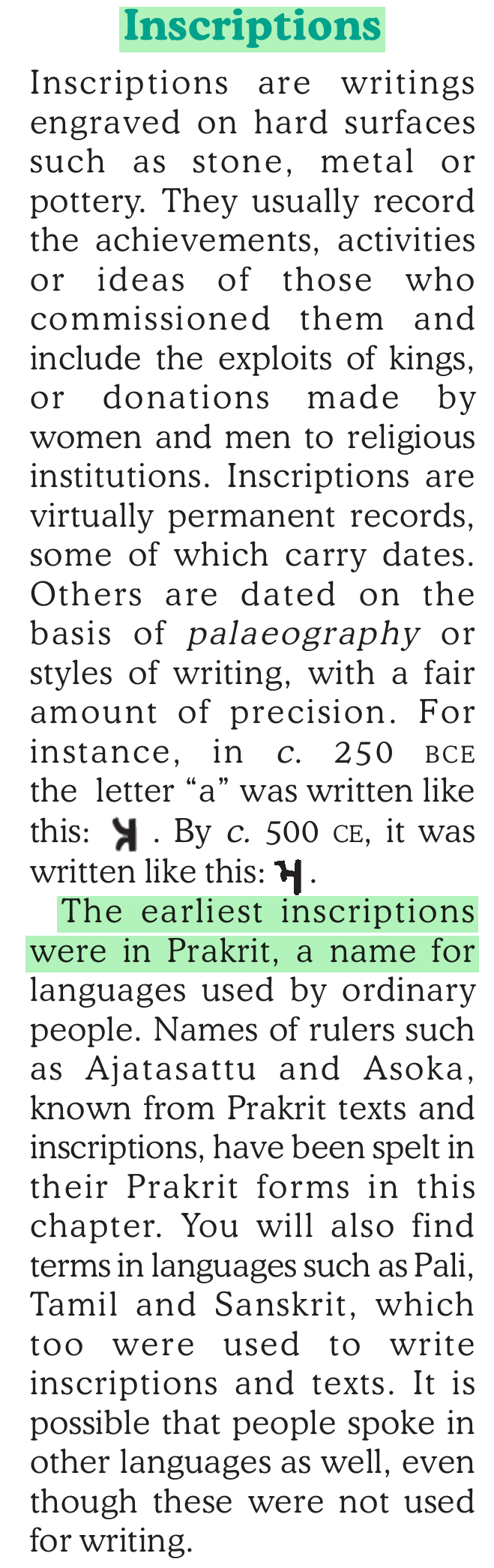
Option (3) Some inscriptions are dated on the basis of ‘palaeography’ — A correct statement (not the answer). Inscriptions without a date are dated by palaeography, the study of styles of writing. The shape of a letter such as ‘a’ changed between c. 250 BCE and c. 500 CE, so the script itself shows the age.

Option (4) The earliest inscriptions were in Sanskrit — Incorrect statement (the answer). The earliest inscriptions were in Prakrit, the name for the languages used by ordinary people. That is why names such as Ajatasattu and Asoka are spelt in their Prakrit forms.


NCERT: Themes in Indian History Part I — Chapter 2: Kings, Farmers and Towns (2025-26)

NCERT extract

Advertisement

Practise more on Ancient India: Kings, Farmers and Towns

Chapter-wise mocks on the real NTA exam screen, with solutions and your rank. Your first mocks are free.

Start free mocks →

Advertisement

Next questions

  1. Identify the most basic compound from the followingChemistry · Organic: Amines
  2. Who led the most ambitious project of preparing a critical edition of Mahabharata in 1919?History · Ancient India: Kinship, Caste and Class
  3. When a ray of light enters from one medium to another, its velocity is doubled. The critical angle in the denser medium will bePhysics · Ray Optics
  4. The introduction of Nile perch into Lake Victoria in East Africa led to the extinction of more than 200 species of cichlid fish in the lake…Biology · Biodiversity and Conservation
  5. Identify the correct statements from below:A. Batai was also called ‘Bhaoli’.B. Khet-batai referred to the division of fields after they we…History · Medieval India: Peasants, Zamindars and the State
  6. Match List-I with List-IIList-IList-IIPhysical QuantityUnit(A) Planck’s constant(I) mathrmkg m^2 s^-3 (B) Stopping potential(II) mathrmkg m…Physics · Dual Nature of Radiation and Matter
  7. Consider the following statements about Kyoto Protocol which was held in Japan in December 1997?(A) Involved pledges and commitments from d…General Aptitude Test · General Knowledge
  8. In late eighteenth-century revenue records, the hill folks living around Rajmahal hills were known as ____________.History · Modern India: Colonialism and the Countryside
  9. The sculpture of ‘a woman water-carrier’ from third-century CE is found at which location?History · Ancient India: Thinkers, Beliefs and Buildings
  10. Which of the following structures represents DDT?Chemistry · Organic: Haloalkanes and Haloarenes