Read the passage and answer the questions:
Buddhism
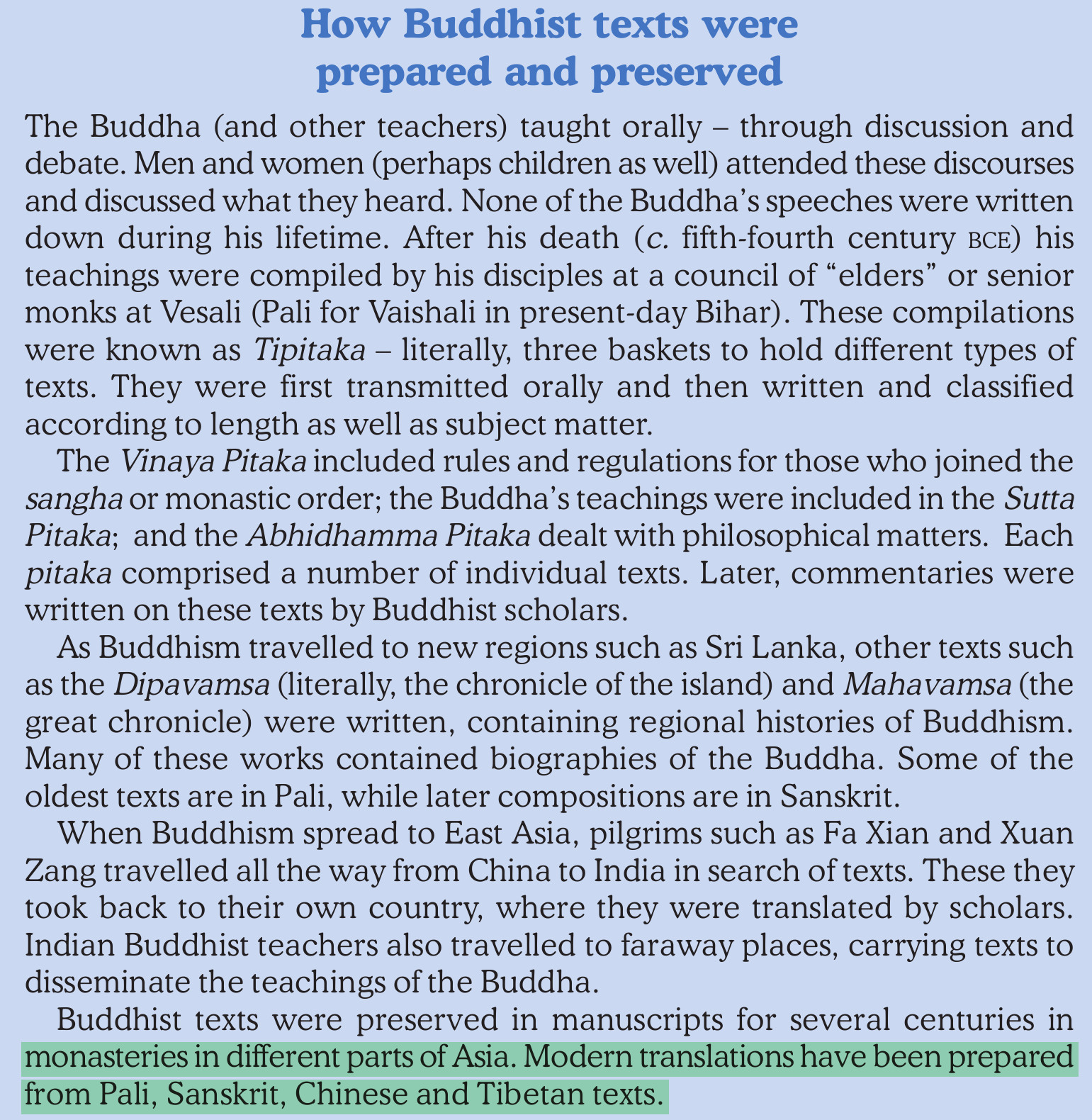
The Buddha (and other teachers) taught orally—through discussion and debate. Men and women (perhaps children as well) attended these discourses and discussed what they heard. None of the Buddha’s speeches were written down during his lifetime. After his death (c. fifth–fourth century BCE), his teachings were compiled by his disciples at a council of “elders” or senior monks at Vesāli (Pali for Vaishali in present-day Bihar). These compilations were known as the Tipitaka—literally, three baskets to hold different types of texts. They were first transmitted orally and then written and classified according to length as well as subject matter. The Vinaya Pitaka included rules and regulations for those who joined the sangha or monastic order; the Buddha’s teachings were included in the Sutta Pitaka; and the Abhidhamma Pitaka dealt with philosophical matters. Each pitaka comprised a number of individual texts. Later, commentaries were written on these texts by Buddhist scholars. As Buddhism traveled to new regions such as Sri Lanka, other texts such as the Dipavamsa (literally, the chronicle of the island) and Mahavamsa (the great chronicle) were written. Many of these works contained biographies of the Buddha. Some of the oldest texts are in Pali, while later compositions are in Sanskrit. When Buddhism spread to East Asia, pilgrims such as Fa Xian and Xuan Zang traveled all the way from China to India in search of texts. These they took back to their own country, where they were translated by scholars. Indian Buddhist teachers also traveled to faraway places, carrying texts to disseminate the teachings of the Buddha. Buddhist texts were preserved in manuscripts for several centuries in monasteries in different parts of Asia. Modern translations have been prepared from Pali, Sanskrit, Chinese, and Tibetan texts.
Modern translations of Buddhist texts have been prepared from __________ texts.
Answer & explanation
Correct answer: option 3
The correct answer is Option (3) → Pali
Buddhist texts were preserved in manuscripts for several centuries in monasteries across Asia. The passage ends by saying that modern translations have been prepared from Pali, Sanskrit, Chinese and Tibetan texts. Of the four options, only Pali is in this list; it is also the language of the oldest Buddhist texts.
NCERT: Themes in Indian History Part I — Chapter 4: Thinkers, Beliefs and Buildings (2025-26)
|