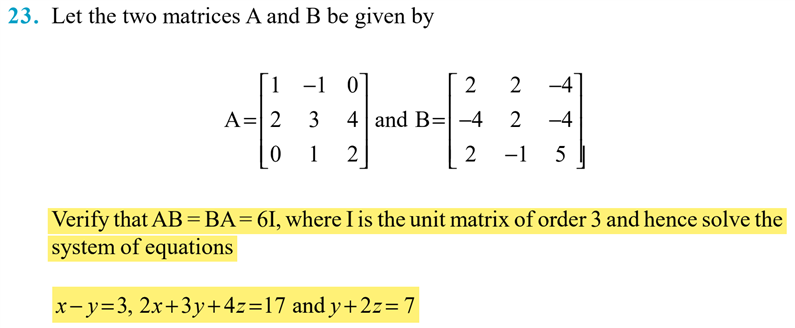
If \( \mathrm{A} \) and \( \mathrm{B} \) are two matrices such that \( \mathrm{A}=\begin{bmatrix} 1 & -1 & 0\\ 2 & 3 & 4\\ 0 & 1 & 2\end{bmatrix} \), \( \mathrm{B}=\begin{bmatrix} 2 & 2 & -4\\ -4 & 2 & -4\\ 2 & -1 & 5\end{bmatrix} \), \( \mathrm{AB}=6\mathrm{I}_{3} \) and the system of linear equation is given by \( x-y=3,\ 2x+3y+4z=17,\ y+2z=7 \), then which of the following are TRUE?
(A) \( \mathrm{A}^{-1}=\displaystyle\frac{1}{6}\mathrm{B} \)
(B) \( x=-1,\ y=2,\ z=4 \)
(C) \( x=2,\ y=-1,\ z=4 \)
(D) \( x=4,\ y=-1,\ z=2 \)
Choose the correct answer from the options given below:
Answer & explanation
Correct answer: option 1
The correct answer is Option (1) → (A) and (C) only
Since \( \mathrm{AB}=6\mathrm{I}_{3} \),
\( \displaystyle \mathrm{A}\left(\frac{1}{6}\mathrm{B}\right)=\mathrm{I}_{3}\ \Rightarrow\ \mathrm{A}^{-1}=\frac{1}{6}\mathrm{B} \)
The system is \( \mathrm{A}X=C \) with the same matrix A, so
\( \displaystyle X=\mathrm{A}^{-1}C=\frac{1}{6}\begin{bmatrix} 2 & 2 & -4\\ -4 & 2 & -4\\ 2 & -1 & 5\end{bmatrix}\begin{bmatrix} 3\\ 17\\ 7\end{bmatrix} \)
\( \displaystyle =\frac{1}{6}\begin{bmatrix} 12\\ -6\\ 24\end{bmatrix} \)
\( \displaystyle =\begin{bmatrix} 2\\ -1\\ 4\end{bmatrix} \)
So \( \mathrm{A}^{-1}=\frac{1}{6}\mathrm{B} \), and the solution is \( x=2,\ y=-1,\ z=4 \).
Checking the statements
(A) \( \mathrm{A}^{-1}=\frac{1}{6}\mathrm{B} \) — Correct. \( \mathrm{AB}=6\mathrm{I}_{3} \) gives \( \mathrm{A}\cdot\frac{1}{6}\mathrm{B}=\mathrm{I}_{3} \).
(B) \( x=-1,\ y=2,\ z=4 \) — Incorrect. Here \( x-y=-3 \), not 3.
(C) \( x=2,\ y=-1,\ z=4 \) — Correct. This is the solution \( X=\mathrm{A}^{-1}C \).
(D) \( x=4,\ y=-1,\ z=2 \) — Incorrect. Here \( x-y=5 \), not 3.
Shortcut: Test the first equation \( x-y=3 \) on the given values:
\( \displaystyle (B):\ -3 \)
\( \displaystyle (C):\ 3 \)
\( \displaystyle (D):\ 5 \)
Only (C) fits, and it also satisfies the other two equations.
NCERT Exemplar:
Determinants