
CUETMOCK
  • Pricing
  • Mentors
Log inStart freeStart free mocks→

First test, then trust

Try a free CUET mock test.

Join 5,00,000+ students who rehearsed exam day on the exact NTA screen before sitting CUET. On the web and on Android.

Start free mocks →Get the Android app
CUETMOCK

India's #1 CUET Mock Test Platform. Original NCERT-based questions on the exact NTA exam screen — trusted by 5,00,000+ students since CUET 2022.

Get it onGoogle PlayScan to download the CUETMOCK app

Mock tests

  • CUET mock test series
  • Browse all papers
  • Commerce mocks
  • Humanities (Arts) mocks
  • Science mocks
  • Languages & GAT mocks
  • Free practice questions
  • Pricing

Resources

  • CUET exam guide
  • CUET syllabus
  • Universities accepting CUET
  • Expert blogs
  • News & notifications
  • Webinars & counselling
  • CUET score calculator
  • How we estimate your rank
  • FAQs

Company

  • About us
  • Our leadership & team
  • Our toppers
  • Mentors
  • For schools
  • Contact us
  • Terms
  • Privacy
  • Refund policy

Talk to us

+91 7696 6630 56info@cuetmock.comWhatsApp us

Our other platforms

  • JEE Mock — For IIT-JEE aspirants
  • NEET Mock — For NEET aspirants

Newsletter

Exam updates, study material and offers — no spam.

© 2026 NYC Ventures Pvt. Ltd.

701-702, Royal Business Park, Zirakpur, Punjab - 140603

  • Terms of use
  • Privacy policy
  • Refund policy
  • Contact us

iCUETMOCK is an independent preparation platform, not affiliated with the National Testing Agency (NTA). Always check exam details on the official NTA website.

  • Home
  • Mock tests
  • CUET guide
  • Pricing
  • Log in
Home/Practice questions/Biology
BiologyHuman Reproduction

After fertilization, the zygote divides to form -

Fertilization and implantation

Read the following passage carefully and answer the given questions.

During copulation semen is released by the penis into the vagina. The motile sperms swim rapidly, pass through the cervix, enter into the uterus and finally reach the ampullary region of the fallopian tube. The ovum released by the ovary is also transported to the ampullary region where fertilisation takes place. During fertilization, a sperm comes in contact with the zona pellucida layer of the ovum and induces changes in the membrane that block the entry of additional sperms. This induces the completion of the meiotic division of the secondary oocyte. The second meiotic division is also unequal and results in the formation of a second polar body and a haploid ovum (ootid). Soon the haploid nucleus of the sperms and that of the ovum fuse together to form a diploid zygote. The zygote undergoes cleavage and forms a blastocyst, which gets implanted in the endometrium of the uterus after about 6-7 days of fertilization. Successful fertilization leads to pregnancy.

After fertilization, the zygote divides to form -

Answer & explanation+

Correct answer: option 3

The correct answer is Option (3) → Morula

After fertilisation the zygote starts to divide by mitosis while it moves towards the uterus. This is called cleavage. It makes 2, 4, 8 and 16 cells called blastomeres. The morula goes on dividing and becomes a blastocyst.

(1) Ovum — Incorrect. The ovum is the female gamete that is released from the ovary. The zygote is formed when a sperm fuses with it.

(2) Yolk sac — Incorrect. This is a membrane outside the embryo that forms later. It is not what the zygote forms by dividing.

(3) Morula — Correct. It is the ball of 8 to 16 blastomeres made by cleavage.

(4) Follicle — Incorrect. A follicle is the structure in the ovary in which the ovum develops.

Note: The passage is taken from NCERT. NTA has put lines of the NCERT text together to make it. Most CUET (UG) questions come straight from NCERT, so study the book line by line, including figures and their titles.

NCERT Extract:
Fertilisation and Implantation – “… The mitotic division starts as the zygote moves through the isthmus of the oviduct called cleavage towards the uterus (Figure 2.11) and forms 2, 4, 8, 16 daughter cells called blastomeres. The embryo with 8 to 16 blastomeres is called a morula (Figure 2.11e). The morula continues to divide and transforms into blastocyst … as it moves further into the uterus.”
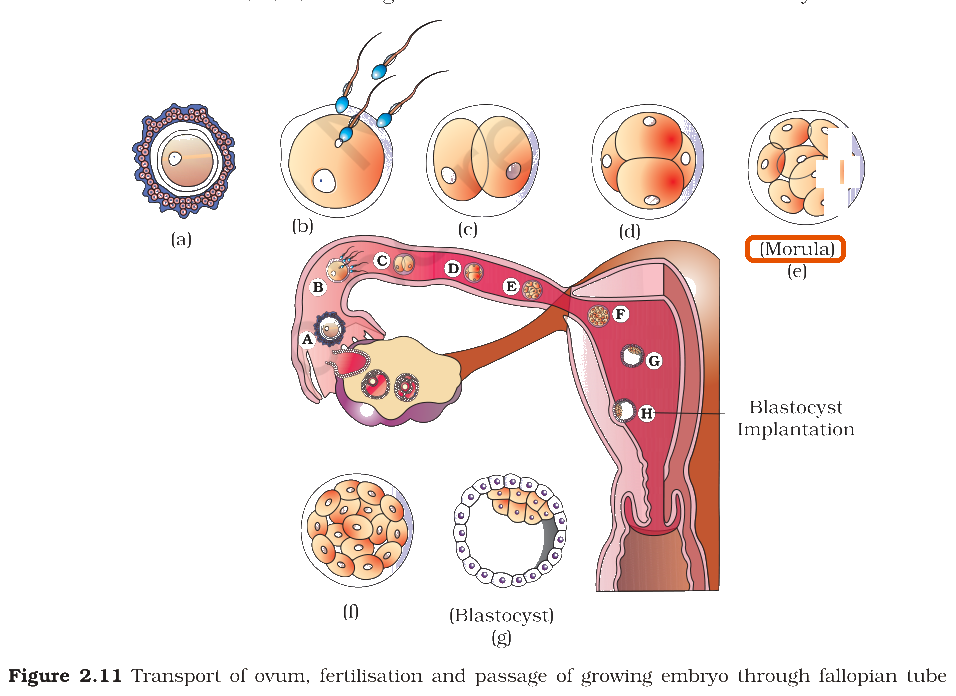
Textbook figure

Advertisement

Practise more on Human Reproduction

Chapter-wise mocks on the real NTA exam screen, with solutions and your rank. Your first mocks are free.

Start free mocks →

Advertisement

Next questions

  1. Arrange the following in the correct order for image formation by a convex lens when the object is between F and 2F.A. Refraction of rays t…Physics · Ray Optics
  2. If a=2imath-3jmath+k,b=-imath+k,c=2jmath-k are three vectors, then area of the parallelogram having diagonals (a+b) and (b+c) isMaths. Section B1 · Vectors
  3. Modern translations of Buddhist texts have been prepared from __________ texts.History · Ancient India: Thinkers, Beliefs and Buildings
  4. Choose the correct word to complete the following sentence:-A word, sentence or a poem that helps you to remember something is termed as-English · One Word
  5. Identify the sea route which is called the Big Trunk Route.Geography · Fundamentals of Human Geography: Transport and Communication
  6. If a-b=4 , b-c=6 and a-c=10 , then the value of a^2+b^2+c^2-ab-bc-ca is:General Aptitude Test · Quantitative Reasoning
  7. In which disease, the substitution of amino acid in the globin protein result from a single base substitution at the sixth codon?Biology · Principles of Inheritance and Variation
  8. Let S be the set of all real numbers and let R be a relation on S, defined by aRb⇔|a-b|≤ 1 . Then, R isMaths. Section B1 · Relations and Functions
  9. The phenomenon, which results in alteration of DNA and results in changes in the genotype and phenotype of an organism is:Biology · Principles of Inheritance and Variation
  10. Match List-I with List-IIList-IName reactionList-IIReagent(A) Wolff Kishner reaction(I) Zn-Hg/HCl(B) Clemmensen reduction reaction(II) NH2N…Chemistry · Organic: Aldehydes, Ketones and Carboxylic Acids