
CUETMOCK
  • Pricing
  • Mentors
Log inStart freeStart free mocks→

First test, then trust

Try a free CUET mock test.

Join 5,00,000+ students who rehearsed exam day on the exact NTA screen before sitting CUET. On the web and on Android.

Start free mocks →Get the Android app
CUETMOCK

India's #1 CUET Mock Test Platform. Original NCERT-based questions on the exact NTA exam screen — trusted by 5,00,000+ students since CUET 2022.

Get it onGoogle PlayScan to download the CUETMOCK app

Mock tests

  • CUET mock test series
  • Commerce mocks
  • Humanities (Arts) mocks
  • Science mocks
  • Languages & GAT mocks
  • Free practice questions
  • Pricing

Resources

  • CUET exam guide
  • CUET syllabus
  • Universities accepting CUET
  • Expert blogs
  • News & notifications
  • Webinars & counselling
  • CUET score calculator
  • How we estimate your rank
  • FAQs

Company

  • About us
  • Our leadership & team
  • Our toppers
  • Mentors
  • For schools
  • Contact us
  • Terms
  • Privacy
  • Refund policy

Talk to us

+91 7696 6630 56info@cuetmock.comWhatsApp us

Our other platforms

  • JEE Mock — For IIT-JEE aspirants
  • NEET Mock — For NEET aspirants

Newsletter

Exam updates, study material and offers — no spam.

© 2026 NYC Ventures Pvt. Ltd.

701-702, Royal Business Park, Zirakpur, Punjab - 140603

  • Terms of use
  • Privacy policy
  • Refund policy
  • Contact us

iCUETMOCK is an independent preparation platform, not affiliated with the National Testing Agency (NTA). Always check exam details on the official NTA website.

  • Home
  • Mock tests
  • CUET guide
  • Pricing
  • Log in
Home/Practice questions/Chemistry
ChemistryOrganic: Amines

The final product D in the following reaction is
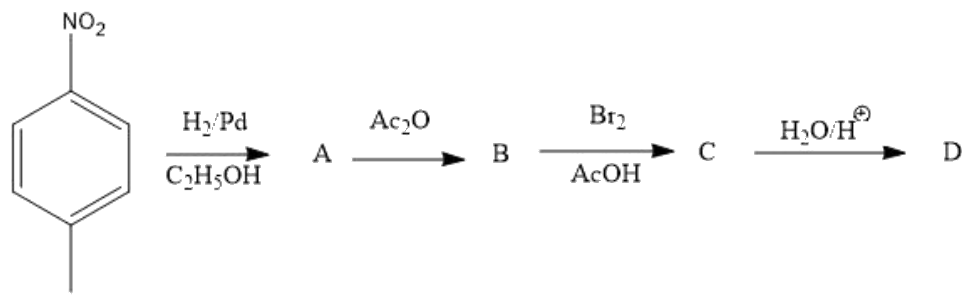
The final product D in the following reaction is

Figure for Q38

Answer & explanation+

Correct answer: option 3

The correct answer is Option (3) → 2-bromo-4-methylaniline

The –\( \ce{NH2} \) group of aniline is so strongly activating that bromination goes straight to the tribromo product. To get a monobromo product, the activating effect is reduced by acetylation (protecting the amino group), then the protecting group is removed by hydrolysis. The acetamido group –\( \ce{NHCOCH3} \) is still ortho/para directing, but less activating, because the nitrogen lone pair is also in resonance with the C=O group.

Following the sequence on p-nitrotoluene:

  • A: \( \ce{H2} \)/Pd reduces –\( \ce{NO2} \) to –\( \ce{NH2} \): p-toluidine (4-methylaniline).

  • B: \( \ce{Ac2O} \) acetylates –\( \ce{NH2} \): N-(4-methylphenyl)acetamide, \( \ce{CH3C6H4NHCOCH3} \).

  • C: \( \ce{Br2} \)/AcOH brominates once. The para position is already taken by \( \ce{CH3} \), and –\( \ce{NHCOCH3} \) is the stronger director, so Br enters ortho to the –NHCOCH3 group: 2-bromo-4-methylacetanilide.

  • D: \( \ce{H3O^{+}} \) hydrolyses the amide back to –\( \ce{NH2} \): 2-bromo-4-methylaniline.

    \( \displaystyle \ce{CH3C6H4NO2 + 3H2} \xrightarrow[\ce{C2H5OH}]{\ce{Pd}} \ce{CH3C6H4NH2 + 2H2O} \)

    \( \displaystyle \ce{CH3C6H4NH2 + (CH3CO)2O -> CH3C6H4NHCOCH3 + CH3COOH} \)

    \( \displaystyle \ce{CH3C6H4NHCOCH3 + Br2} \xrightarrow{\ce{CH3COOH}} \ce{CH3C6H3(Br)NHCOCH3 + HBr} \)

    \( \displaystyle \ce{CH3C6H3(Br)NHCOCH3 + H2O} \xrightarrow{\ce{H+}} \ce{CH3C6H3(Br)NH2 + CH3COOH} \)

In structure 3 the Br is next to the \( \ce{NH2} \) group and the \( \ce{CH3} \) is para to it.

Why the other options are incorrect

  • Option (1) 4-bromo-2-methylaniline — Incorrect. Here Br is para and \( \ce{CH3} \) ortho to \( \ce{NH2} \); but the \( \ce{CH3} \) was para to nitrogen from the start and cannot move.

  • Option (2) 3-bromo-4-methylaniline — Incorrect. Br is meta to the amino group, i.e. ortho to \( \ce{CH3} \); the stronger –\( \ce{NHCOCH3} \) director sends Br ortho to itself instead.

  • Option (4) 3,5-dibromo-4-methylaniline — Incorrect. Only one Br is introduced (the acetyl group prevents polybromination), and both Br atoms here are meta to nitrogen.

NCERT (2026-27 edition):
Electrophilic Substitution – …
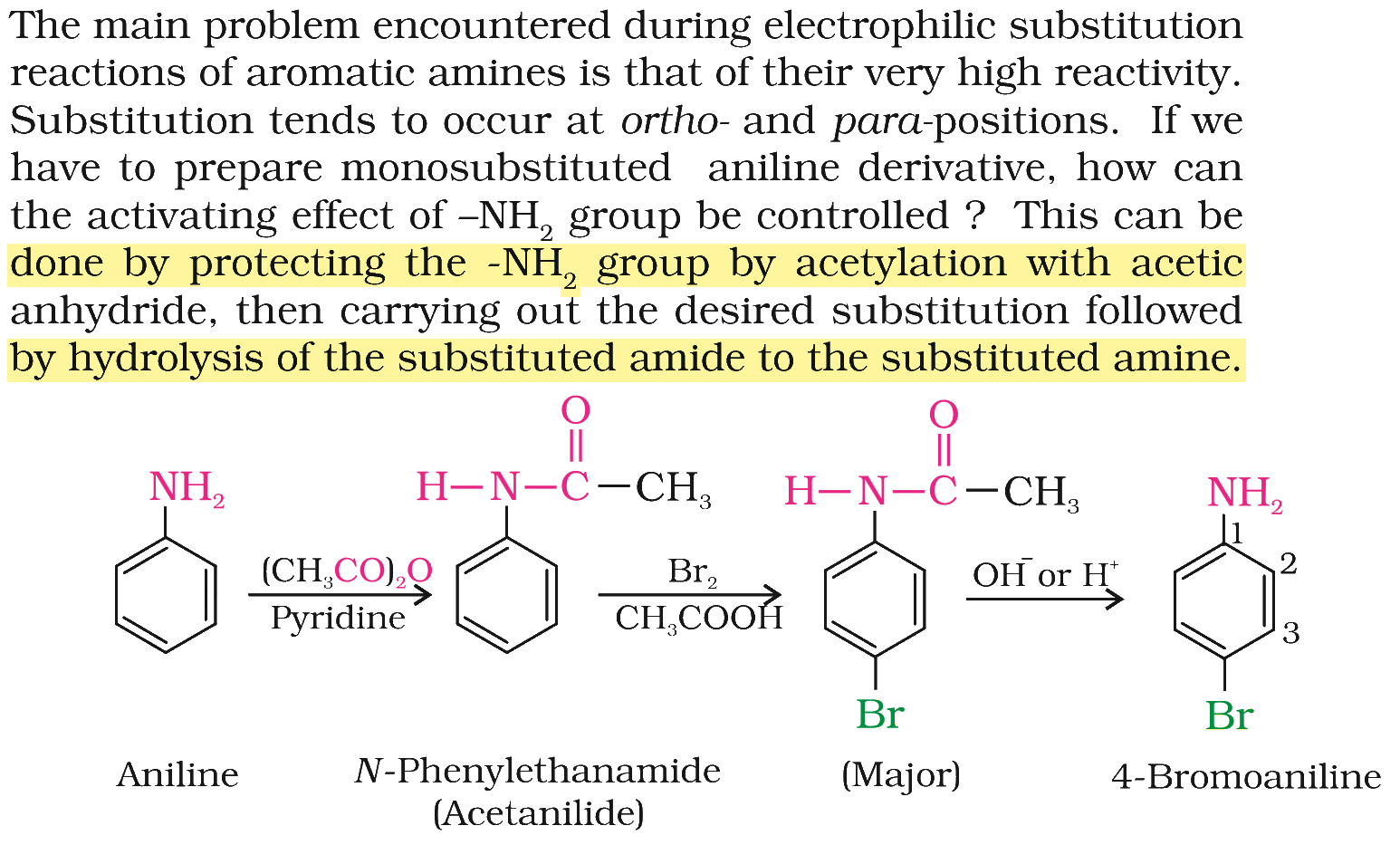
Textbook extract

Advertisement

Practise more on Organic: Amines

Chapter-wise mocks on the real NTA exam screen, with solutions and your rank. Your first mocks are free.

Start free mocks →

Advertisement

Next questions

  1. Two resistances, 10 Ω and 20 Ω, are connected in series circuit A and then in parallel in circuit B with a battery of 24 V.Choose the corre…Physics · Current Electricity
  2. The figure below represents the graph between ln k vs 1/T. The slope of the straight line will beChemistry · Physical: Chemical Kinetics
  3. Study the given pattern carefully and select the number that can replace the question mark (?) in it.General Aptitude Test · Verbal Reasoning
  4. GEAC stands for -Biology · Biotechnology and its Applications
  5. Identify the correct statements.A. The former USSR pioneered space research.B. APPLE was an experimental satellite launched by the USA.C. I…Geography · Fundamentals of Human Geography: Transport and Communication
  6. Match List-I with List-IIList-IList-II(A)Book value of an asset at a given date(I)Original value of the asset - scrap value of the asset(B)…Applied Maths. Section B2 · Financial Mathematics
  7. Which of the following will be most easily attacked by an electrophile?Chemistry · Organic: Alcohols, Phenols and Ethers
  8. Kirchhoff's loop rule is based on-Physics · Current Electricity
  9. The solubility of a solid in a liquid is significantly affected by temperature changes. This can be explained using theChemistry · Physical: Solutions
  10. Which one of the following dyes is used for the visualization of DNA in electrophoresis?Biology · Biotechnology -Principles and Processes