Which of the following will be most easily attacked by an electrophile?
Answer & explanation
Correct answer: option 3
The correct answer is Option (3) → phenol
An electrophile seeks electrons, so it attacks a benzene ring more easily when the ring is richer in electrons. A substituent changes the electron density of the ring:
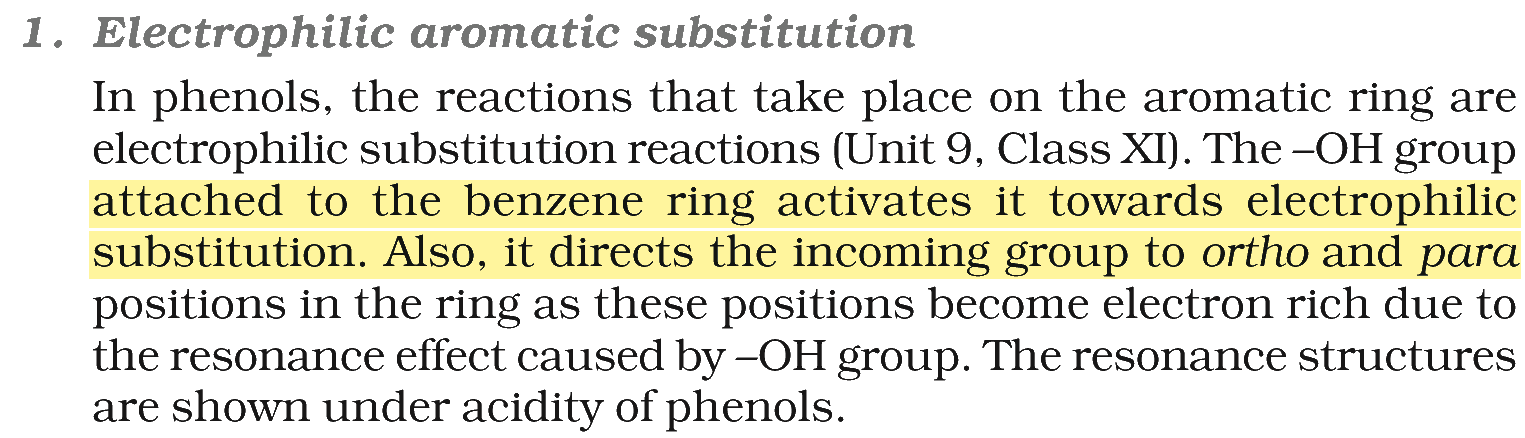
–OH (phenol): the lone pair on oxygen is delocalised into the ring by resonance (+R effect), strongly increasing the electron density at the ortho and para positions. It is a strongly activating group.
–CH3 (toluene): releases electrons by the +I effect and hyperconjugation; activating, but much weaker than –OH.
–Cl (chlorobenzene): its –I effect withdraws more electron density than its +R effect gives back, so the ring is deactivated (though still ortho/para directing).
\( \displaystyle \ce{C6H5OH} \gt \ce{C6H5CH3} \gt \ce{C6H6} \gt \ce{C6H5Cl} \)
So phenol is most easily attacked by an electrophile.
Why the other options are incorrect
Option (1) chlorobenzene — Incorrect. The –Cl group deactivates the ring, so it reacts even more slowly than benzene.
Option (2) benzene — Incorrect. It has no activating group; it is the reference compound.
Option (4) toluene — Incorrect. –\( \ce{CH3} \) activates the ring, but only weakly compared with –OH.
NCERT (2026-27 edition):
Electrophilic Aromatic Substitution