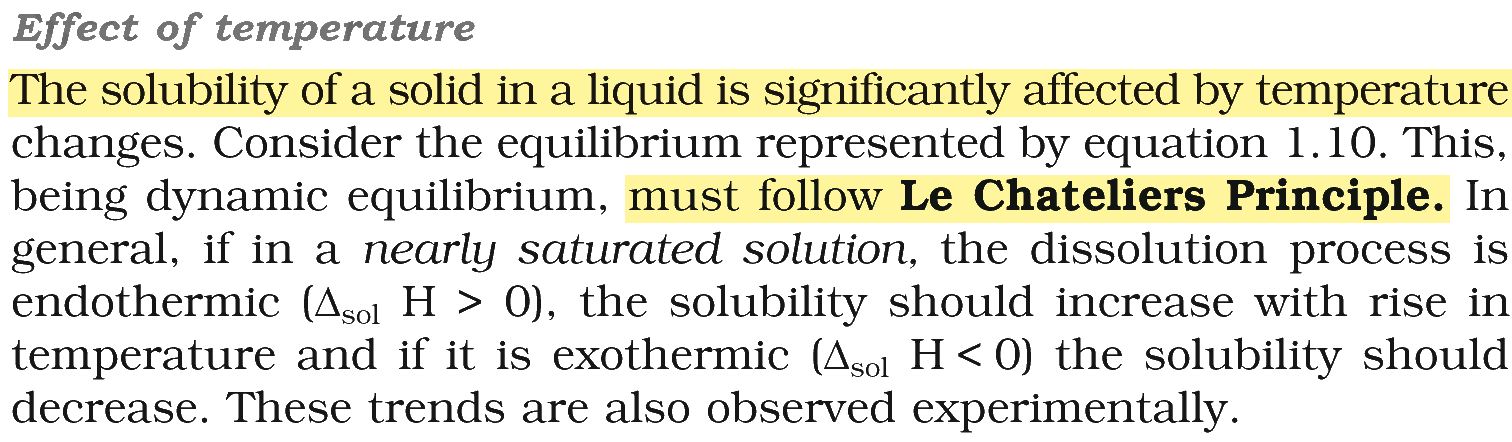
The solubility of a solid in a liquid is significantly affected by temperature changes. This can be explained using the
Answer & explanation
Correct answer: option 2
The correct answer is Option (2) → Le-Chateliers Principle
When a solid is added to a liquid until no more dissolves, the solution is saturated, and the dissolved and undissolved solute are in dynamic equilibrium:
\( \displaystyle \text{Solute} + \text{Solvent} \ce{<=>} \text{Solution} \)
A change of temperature disturbs this equilibrium, and the system shifts so as to oppose the change. This is Le Chatelier’s principle, applied to the solubility equilibrium.
Why the other options are incorrect
Option (1) Raoult’s law — Incorrect. It relates the vapour pressure of a component to its mole fraction in the solution, not solubility.
Option (3) Dalton’s Law — Incorrect. It states that the total pressure of a gas mixture is the sum of the partial pressures of its gases.
Option (4) Henry’s Law — Incorrect. It relates the solubility of a gas in a liquid to its partial pressure (p = KH x); it does not deal with solids or with temperature.
NCERT (2026-27 edition):
Effect of Temperature