Comprehension:
Solutions
The solution which obeys Raoult's law over the entire range of concentration are known as ideal solutions and which does not obey are known as non-ideal solution. The vapour pressure of a non ideal solution is either higher or lower than that predicted by Raoult's law equation. The colligative properties, which depend on the number of solute particles irrespective of their nature, are relative lowering of vapour pressure, depression of freezing point, elevation of boiling point and osmotic pressure. All these properties can be utilised for the determination of molar mass of the solute.
A solution is made by adding carbon disulphide to acetone. The solution shows positive deviation from Raoult's law because
Answer & explanation
Correct answer: option 1
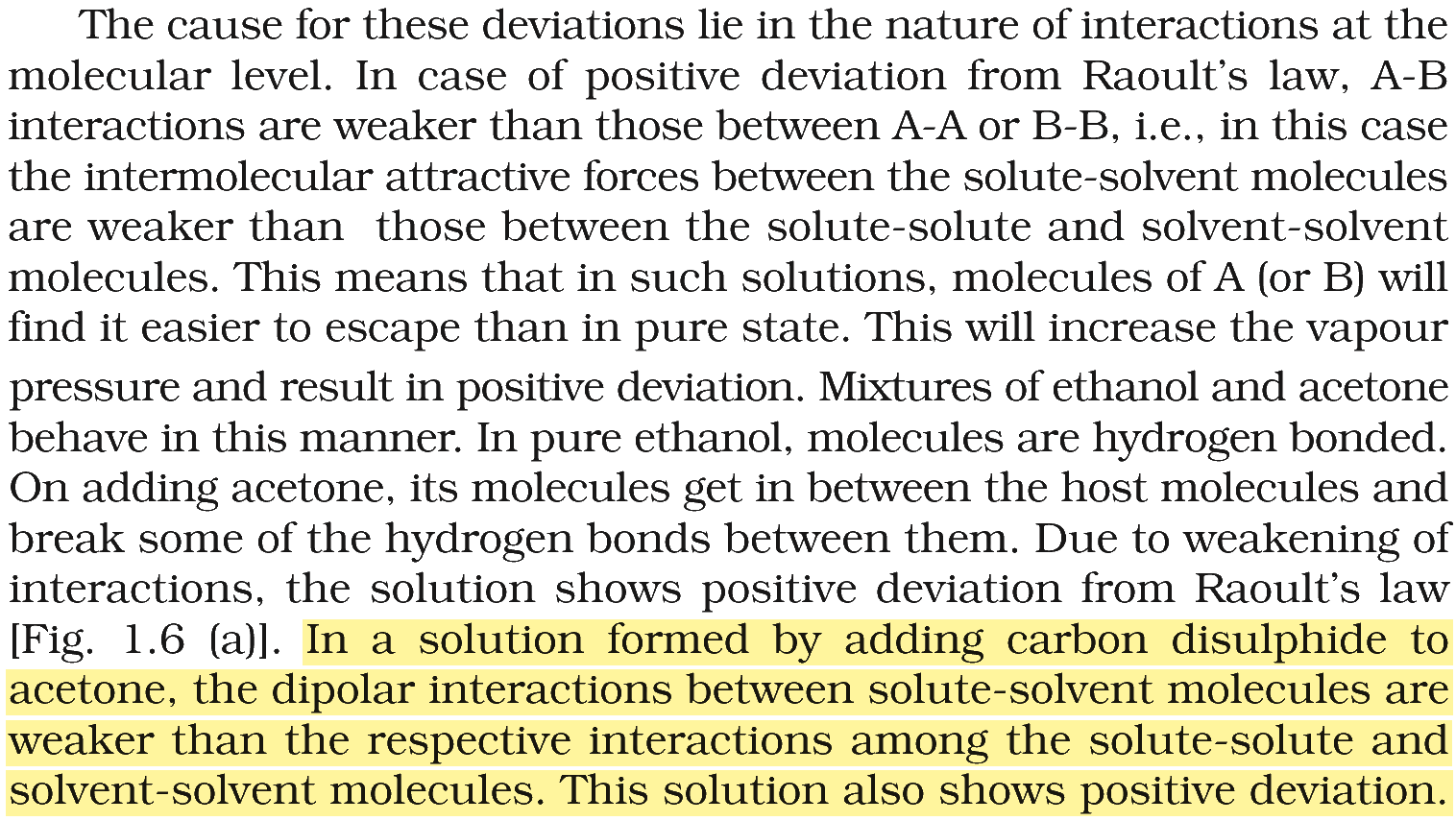
The correct answer is Option (1) → The dipolar interactions between solute-solvent molecules are weaker than the respective interactions among the solute-solute and solvent-solvent molecules.
The acetone–\( \ce{CS2} \) interactions are weaker than the dipolar interactions they replace, so the solution shows positive deviation.
Why the other options are incorrect
Option (2) Solute – solvent react very fast — Incorrect. Acetone and carbon disulphide do not react; deviations are about the strength of intermolecular forces, not chemical reaction.
Option (3) Solute – solvent interactions are equal to solute – solute interactions — Incorrect. Equal interactions give an ideal solution with no deviation.
Option (4) The dipolar interactions between solute-solvent are stronger than the respective interactions among the solute- solute and solvent-solvent interactions — Incorrect. Stronger A–B interactions cause negative deviation, as in chloroform + acetone, where a hydrogen bond forms between them.
NCERT (2026-27 edition):
Non-ideal Solutions – …