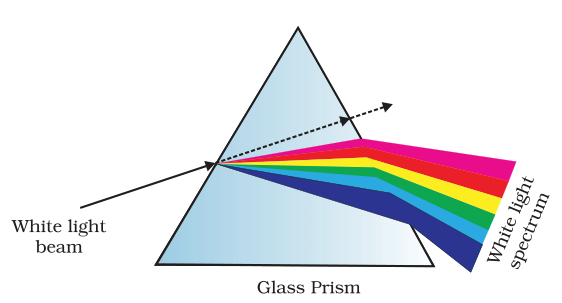
The refractive index of a glass is 1.520 for red light and 1.525 for blue light. If the angles of deviation be Dr and Db for red and blue light, respectively, in a thin prism of this glass, then
Answer & explanation
Correct answer: option 1
The correct answer is Option (1) → Dr < Db
For a thin prism of angle A, the deviation depends only on the refractive index for that colour.
\( \displaystyle D = (\mu - 1)A \)
\( \displaystyle D_r = (1.520 - 1)A = 0.520\,A \)
\( \displaystyle D_b = (1.525 - 1)A = 0.525\,A \)
Since \( \mu_b \gt \mu_r \), blue light is deviated more than red for any angle A, so \( D_r \lt D_b \).
Note: This question is from the pre-rationalised NCERT book (2022-23). The topic was removed from the latest NCERT book (2026-27), but it is still in the CUET 2026 syllabus, so do not skip it.
NCERT (Pre-rationalised edition, 2022-23):
Dispersion by a Prism – “It has been known for a long time that when a narrow beam of sunlight, usually called white light, is incident on a glass prism, the emergent light is seen to be consisting of several colours. … The red light bends the least, while the violet light bends the most (Fig. 9.25).”