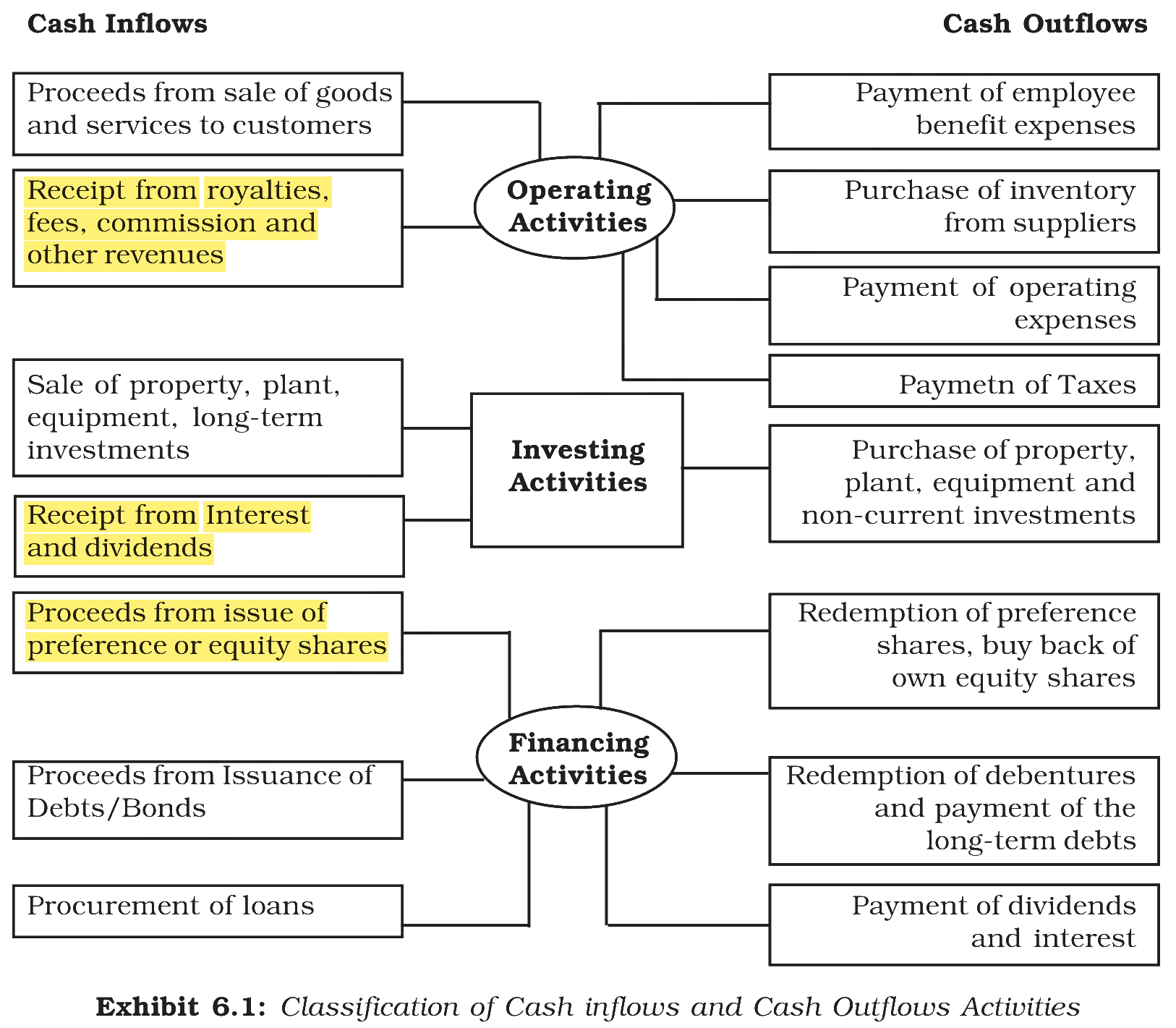
Match the LIST-I with LIST-II
| LIST-I | LIST-II | ||
| A. | Demand deposits with banks is | I. | Cash flow from operating activities |
| B. | Cash receipts from royalties, fees, commissions and other revenues | II. | Cash flow from investing activities |
| C. | Interest received in cash from loans and advances | III. | Cash flow from financing activities |
| D. | Cash proceeds from issuing shares | IV. | Cash and cash equivalents |
Choose the correct answer from the options given below:
Answer & explanation
Correct answer: option 1
The correct answer is Option (1) → A-IV, B-I, C-II, D-III
A cash flow statement sorts cash flows into operating, investing and financing activities, and explains the change in cash and cash equivalents.
(A) Demand deposits with banks is — this matches (IV) Cash and cash equivalents. As per AS-3, cash means cash in hand and demand deposits with banks.
(B) Cash receipts from royalties, fees, commissions and other revenues — this matches (I) Cash flow from operating activities. They come from the main revenue-earning activities of the business.
(C) Interest received in cash from loans and advances — this matches (II) Cash flow from investing activities. For a firm that is not a financial enterprise, loans and advances given are investments, so the interest on them is an investing inflow.
(D) Cash proceeds from issuing shares — this matches (III) Cash flow from financing activities. It changes the owners’ capital of the company.
NCERT (2026-27 edition): NCERT (2026-27 edition):
|