CUETMOCK
  • Pricing
  • Mentors
Log inStart freeStart free mocks→

First test, then trust

Try a free CUET mock test.

Join 5,00,000+ students who rehearsed exam day on the exact NTA screen before sitting CUET. On the web and on Android.

Start free mocks →Get the Android app
CUETMOCK

India's #1 CUET Mock Test Platform. Original NCERT-based questions on the exact NTA exam screen — trusted by 5,00,000+ students since CUET 2022.

Get it onGoogle PlayScan to download the CUETMOCK app

Mock tests

  • CUET mock test series
  • Browse all papers
  • Commerce mocks
  • Humanities (Arts) mocks
  • Science mocks
  • Languages & GAT mocks
  • Free practice questions
  • Pricing

Resources

  • CUET exam guide
  • CUET syllabus
  • Universities accepting CUET
  • Expert blogs
  • News & notifications
  • Webinars & counselling
  • CUET score calculator
  • How we estimate your rank
  • FAQs

Company

  • About us
  • Our leadership & team
  • Our toppers
  • Mentors
  • For schools
  • Contact us
  • Terms
  • Privacy
  • Refund policy

Talk to us

+91 7696 6630 56info@cuetmock.comWhatsApp us

Our other platforms

  • JEE Mock — For IIT-JEE aspirants
  • NEET Mock — For NEET aspirants

Newsletter

Exam updates, study material and offers — no spam.

© 2026 NYC Ventures Pvt. Ltd.

701-702, Royal Business Park, Zirakpur, Punjab - 140603

  • Terms of use
  • Privacy policy
  • Refund policy
  • Contact us

iCUETMOCK is an independent preparation platform, not affiliated with the National Testing Agency (NTA). Always check exam details on the official NTA website.

  • Home
  • Mock tests
  • CUET guide
  • Pricing
  • Log in
Home/Practice questions/Psychology
PsychologyMeeting Life Challenges

Identify the stages of General Adaptation Syndrome (Selye):(A) Alarm…

Identify the stages of General Adaptation Syndrome (Selye):

(A) Alarm reaction stage

(B) Exhaustion stage

(C) Reaction stage

(D) Resistance stage

Answer & explanation+

Correct answer: option 4

The correct answer is Option (4) → (A), (B), and (D) only

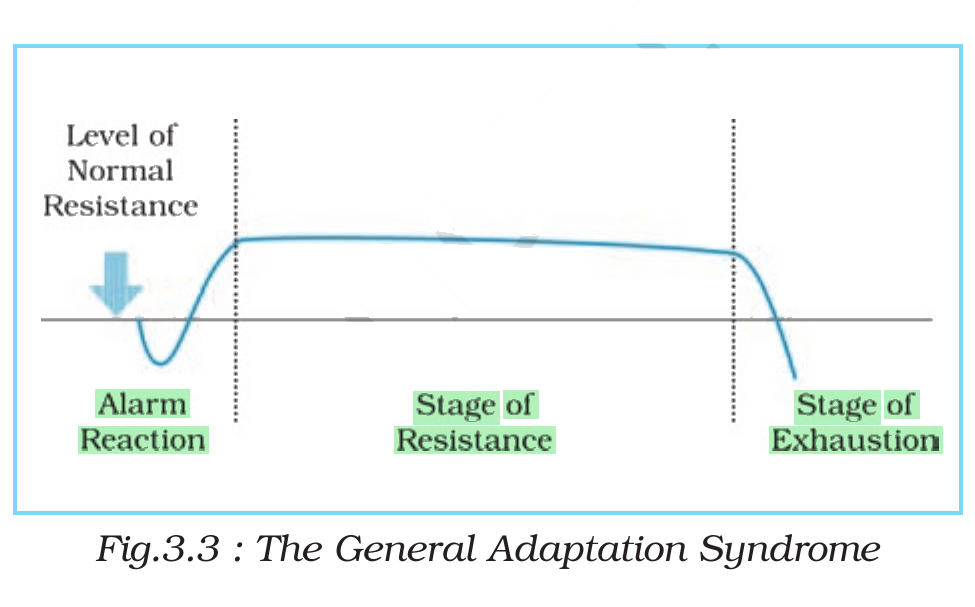
Selye found a similar pattern of bodily response to prolonged stress in all his subjects and called it the General Adaptation Syndrome. It has three stages.

(A) Alarm reaction stage Correct. The first stage: a stressor activates the adrenal-pituitary-cortex system, hormones producing the stress response are released, and the person is ready for fight or flight.

(B) Exhaustion stage Correct. The third stage: continued exposure to the stressor drains the body of its resources, and susceptibility to stress-related diseases rises.

(C) Reaction stage Incorrect. The model has no stage of this name; ‘reaction’ is half of the name of the first stage, the alarm reaction.

(D) Resistance stage Correct. The second stage: if stress is prolonged, the parasympathetic nervous system calls for more cautious use of the body’s resources and the organism tries to cope with the threat.


NCERT (2025-26): “General Adaptation Syndrome … What happens to the body when stress is prolonged? Selye studied this issue by subjecting animals to a variety of stressors such as high temperature, X-rays and insulin injections, in the laboratory over a long period of time. He also observed patients with various injuries and illnesses in hospitals. Selye noticed a similar pattern of bodily response in all of them. He called this patter n the General Adaptation Syndrome (GAS). According to him, GAS involves three stages: alarm reaction, resistance, and exhaustion (see Fig.3.3).

  • 1. Alarm reaction stage : The presence of a noxious stimulus or stressor leads to activation of the adrenalpituitary-cortex system. This triggers the release of hormones producing the stress response. Now the individual is ready for fight or flight.

  • 2. Resistance stage : If stress is prolonged, the resistance stage begins. The parasympathetic nervous system calls for mor e cautious use of the body’s resources. The organism makes efforts to cope with the threat, as through confrontation.

  • 3. Exhaustion stage : Continued exposure to the same stressor or additional stressors drains the body of its resources and leads to the third stage of exhaustion. The physiological systems involved in alarm reaction and resistance become inef fective and susceptibility to stress-related diseases such as high blood pressure becomes more likely.…”

NCERT extract

Advertisement

Practise more on Meeting Life Challenges

Chapter-wise mocks on the real NTA exam screen, with solutions and your rank. Your first mocks are free.

Start free mocks →

Advertisement

Next questions

  1. Match the LIST-I with LIST-IILIST-ILIST-IIA.Preparation of Profit & Loss Suspense A/cI.Admission of a partnerB.When firm requires additiona…Accountancy Part A · Admission of a Partner
  2. Choose the correct synonym of the following word: CONUNDRUMEnglish · Synonyms
  3. One of the most important descriptions of the city of Vijayanagara in the fifteenth-century comes from ____________.History · Medieval India: Through the Eyes of Travellers
  4. Match the LIST-I with LIST-IILIST-I(Coalition Government since 1989)LIST-II(Alliance partners and supporters)A.National Front (1989-1990)I.…Political Science · Politics in India Since Independence: Recent Developments in Indian Politics
  5. Which of the following is a leguminous crop?General Aptitude Test · General Knowledge
  6. A proton is projected towards the east in a magnetic field. It is deflected towards north. The direction of the field may bePhysics · Moving Charges and Magnetism
  7. The Deccan Traps of India, covering most of the Maharashtra Plateau, is an example of which type of volcanic rock?General Aptitude Test · General Knowledge
  8. Which of the image will form based on the given image?General Aptitude Test · Non-Verbal Reasoning
  9. In the following reaction, the major product A isChemistry · Organic: Aldehydes, Ketones and Carboxylic Acids
  10. Rearrange the following phrases into a meaningful sentence. The beginning of the sentence has been given below.In early boxing,A. the fight…English · Arrange in Meaningful Sequence