
In the following reaction, the major product A is
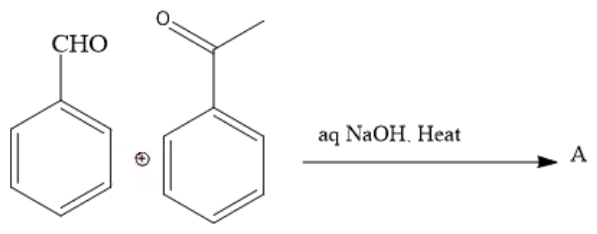
Answer & explanation
Correct answer: option 3
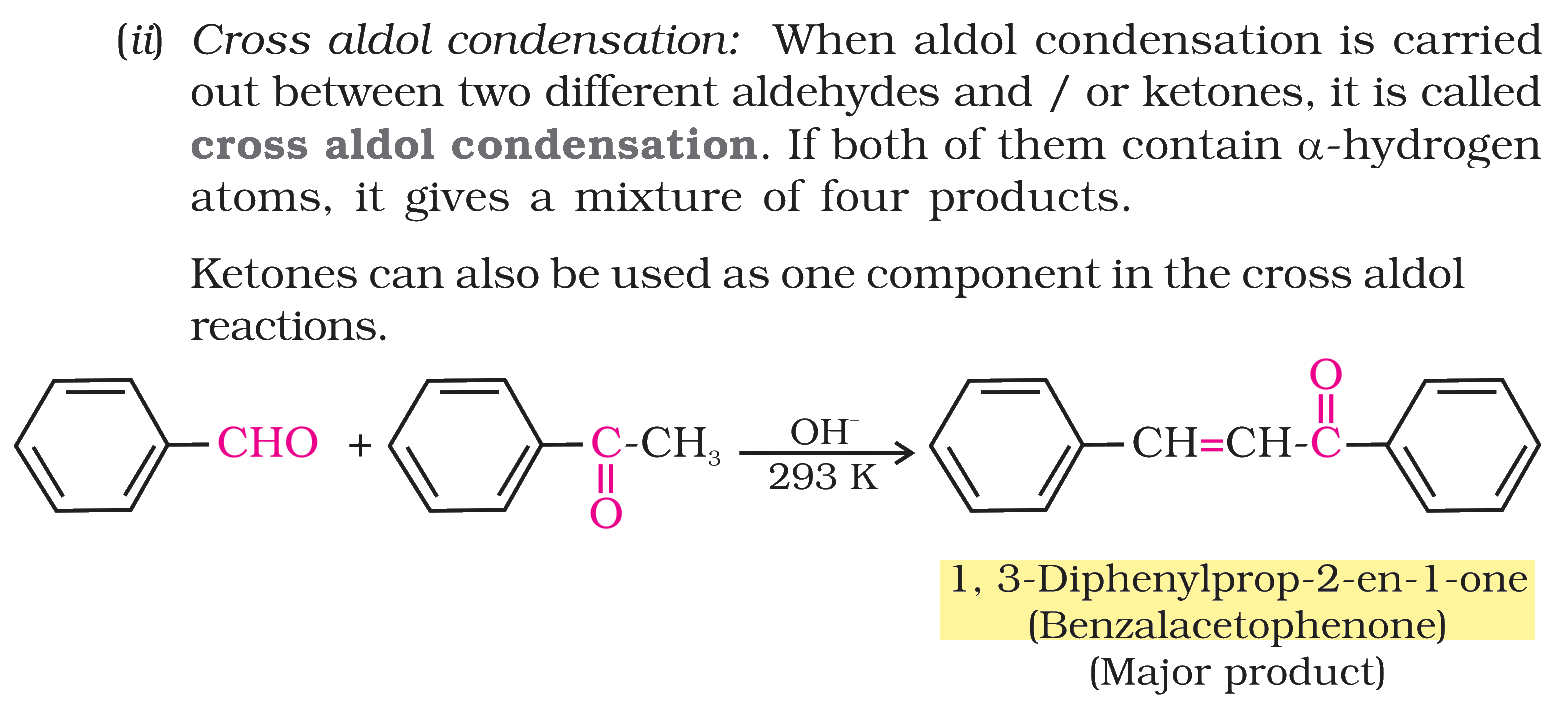
The correct answer is Option (3) → 1,3-diphenylprop-2-en-1-one (benzalacetophenone)
When an aldehyde or ketone that has α-hydrogens is treated with dilute alkali, it forms a carbanion (enolate) that adds to the C=O group of another carbonyl compound. This is the aldol reaction; it gives a β-hydroxy carbonyl compound, which on heating loses water to give an α,β-unsaturated carbonyl compound (aldol condensation).
When an aromatic aldehyde without α-hydrogens reacts with a ketone that has them, the crossed product is formed cleanly. This is the Claisen–Schmidt condensation:
Acetophenone (\( \ce{C6H5COCH3} \)) has α-hydrogens; \( \ce{OH^{-}} \) removes one to form the carbanion.
Benzaldehyde has no α-hydrogen, so it can only accept the carbanion at its C=O carbon.
\( \displaystyle \ce{C6H5CHO + CH3COC6H5} \xrightarrow{\text{aq }\ce{NaOH}} \ce{C6H5CH(OH)CH2COC6H5} \)
\( \displaystyle \ce{C6H5CH(OH)CH2COC6H5} \xrightarrow[-\ce{H2O}]{\text{heat}} \ce{C6H5CH=CH-CO-C6H5} \)
The double bond forms in conjugation with both the benzene ring and the C=O group, which makes the product very stable. So A is C6H5CH=CH–CO–C6H5, benzalacetophenone (chalcone).
Why the other options are incorrect
Option (1) 1,3-diphenylpropan-1-ol — Incorrect. Both the C=C and the C=O have been reduced; NaOH is not a reducing agent.
Option (2) 1,3-diphenylpropan-1-one — Incorrect. This is the saturated ketone; it would need the C=C bond to be hydrogenated.
Option (4) 1,3-diphenylprop-2-en-1-ol — Incorrect. Only the C=O group has been reduced to CH–OH; NaOH is not a reducing agent, so this alcohol is not formed.
NCERT (2026-27 edition):
Cross Aldol Condensation
Note: The same/similar question has been asked in different years by NTA as per the details given below:
| 2026 | 2025 | 2024 | 2023 | 2022 |
|---|---|---|---|---|
| 19-05 S1 18-05 S1 | – | – | – | – |