At what rate of interest will the present value of the perpetuity of Rs. 10,000 payable at the end of every six months be Rs. 2,00,000 ?
Answer & explanation
Correct answer: option 1
The correct answer is Option (1) → 10 % per annum
Note: The given answer is as per the official NTA Answer Key. However, the question does not say whether the rate per annum is the nominal rate or the effective annual rate, and with the effective-rate reading Option (4) could also be a possible answer, as explained below.
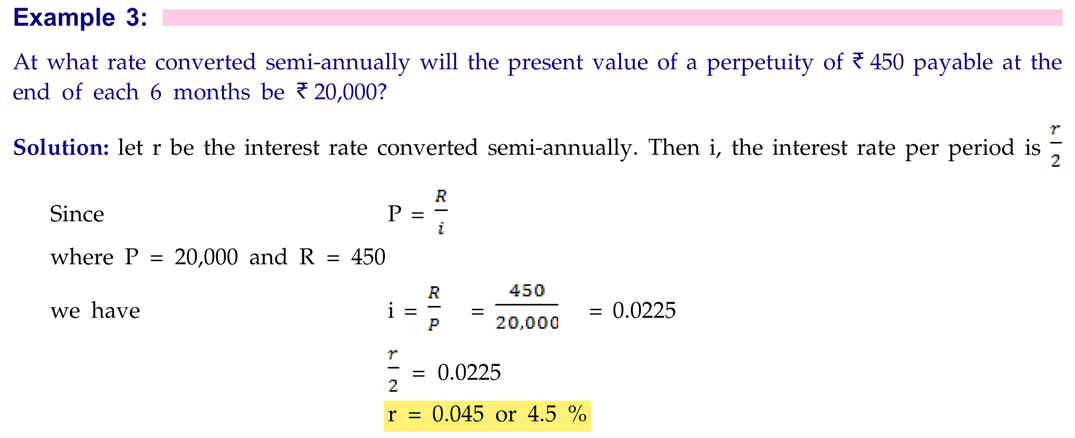
For a perpetuity, with i the rate for each six-month period:
\( \displaystyle \text{PV}=\frac{P}{i} \)
\( \displaystyle 200000=\frac{10000}{i} \)
\( \displaystyle i=0.05=5\%\text{ per six months} \)
The nominal rate per annum (two half-years):
\( \displaystyle 2\times 5\%=10\% \)
The effective rate per annum (interest compounded half-yearly):
\( \displaystyle (1.05)^{2}-1=0.1025=10.25\% \)
Option (1) 10 % per annum — Correct. Rs. 10,000 every six months is 5% of Rs. 2,00,000 for each half-year. Counted as a nominal yearly rate, this is 2 × 5% = 10% per annum.
Option (2) 8 % per annum — Incorrect. It is neither the nominal rate (10%) nor the effective rate (10.25%).
Option (3) 12 % per annum — Incorrect. It is neither the nominal rate (10%) nor the effective rate (10.25%).
Option (4) 10.25 % per annum — Should also be correct, though not the answer given by NTA. The 5% earned in the first half-year also earns interest in the second half-year, so Rs. 100 grows to Rs. 110.25 in one year. Counted as the effective yearly rate, this is 10.25% per annum.
CBSE Applied Mathematics (Class XII):
Perpetuity