Principles and processes of biotechnology
Read the following passage carefully and answer the given questions.
The DNA fragments separate according to their size through sieving effect provided by the agarose gel. Vectors used at present, are engineered in such a way that they help easy linking of foreign DNA and selection of recombinants from non-recombinants. If we are able to link an alien piece of DNA with bacteriophage or plasmid DNA, we can multiply its numbers equal to the copy number of the plasmid or bacteriophage. In the year 1963, the two enzymes responsible for restricting the growth of bacteriophage in Escherichia coli were isolated. One of these added methyl groups to DNA, while the other cut DNA. The latter was called restriction endonuclease. The first restriction endonuclease - Hind II, whose functioning depended on a specific DNA nucleotide sequence was isolated and characterised five years later. In PCR reaction, multiple copies of the gene of interest are synthesised in vitro using two sets of primers (small chemically synthesised oligonucleotides that are complementary to the regions of DNA). Modern biotechnology using genetically modified organisms was made possible only when man learnt to alter the chemistry of DNA and construct recombinant DNA. This key process is called recombinant DNA technology or genetic engineering.
Which one of the following techniques is used for the separation and isolation of DNA fragments?
Answer & explanation
Correct answer: option 2
The correct answer is Option (2) → Agarose gel electrophoresis
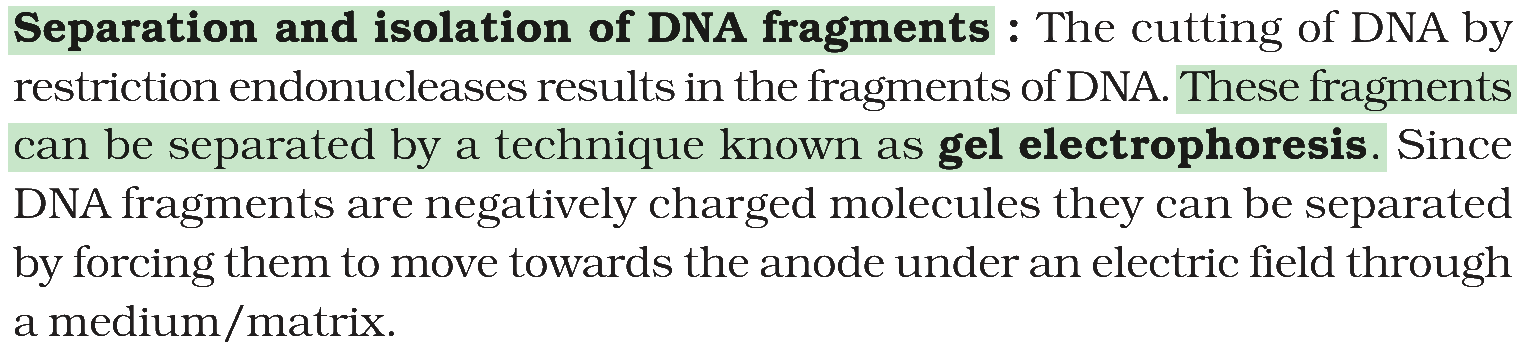
When DNA is cut by restriction endonucleases, many fragments are formed. They are separated by gel electrophoresis. DNA is negatively charged, so in an electric field the fragments move through the gel towards the anode. The agarose gel works like a sieve: smaller fragments move farther and larger ones stay nearer the start.
(1) Autoradiography — Incorrect. This detects radioactive DNA on an X-ray film, as in DNA fingerprinting. It does not separate the fragments.
(2) Agarose gel electrophoresis — Correct. It separates the fragments by size, and the bands can then be cut out of the gel to isolate the fragments. The DNA is made visible by staining with ethidium bromide and exposure to UV light.
(3) Centrifugation — Incorrect. This spins a mixture so that heavier particles settle. It is not the technique used to separate DNA fragments by their size.
(4) PCR — Incorrect. PCR (polymerase chain reaction) makes many copies of a chosen DNA segment. It does not separate fragments.
Note 1: The passage is taken from NCERT. NTA has put lines of the NCERT text together to make it. Most CUET (UG) questions come straight from NCERT, so study the book line by line, including figures and their titles.
Note 2: A similar question was also asked in CUET (UG) 2026 on 25-05-2026 (Slot 1), and in CUET (UG) 2025 on 28-05-2025 (Slot 1) and on 23-05-2025 (Slot 2).
NCERT Extract:
Restriction Enzymes – …