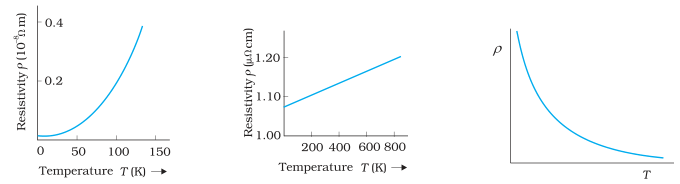
The following statements are given regarding the resistivity of a material. Identify the correct statements:
A. Resistivities of different materials exhibit the same dependence on temperature.
B. Metals have low resistivities in the range of 10−8 Ωm to 10−6 Ωm. Insulators have resistivities 1018 times greater than metals or more.
C. The resistivities of semiconductors decrease with increasing temperatures.
D. Some materials like nichrome, manganin and constantan exhibit a very weak dependence of resistivity with temperature.
Choose the correct answer from the options given below:
Answer & explanation
Correct answer: option 3
The correct answer is Option (3) → B, C and D only
How resistivity changes with temperature depends on the kind of material: in metals collisions increase with temperature, while in semiconductors the number of charge carriers grows rapidly.
(A) Resistivities of different materials exhibit the same dependence on temperature. — Incorrect. Metal resistivity increases with temperature, semiconductor resistivity decreases, and alloys such as manganin hardly change.
(B) Metals have low resistivities in the range of 10−8 Ωm to 10−6 Ωm. Insulators have resistivities 1018 times greater than metals or more. — Correct. These are the standard ranges for conductors and insulators.
(C) The resistivities of semiconductors decrease with increasing temperatures. — Correct. Heating frees more charge carriers, so the carrier density rises.
(D) Some materials like nichrome, manganin and constantan exhibit a very weak dependence of resistivity with temperature. — Correct. Their very small temperature coefficient makes them suitable for standard resistors.
NCERT (2026-27):
Resistivity of Various Materials – “… Metals have low resistivities in the range of \( 10^{-8}\,\Omega\mathrm{m} \) to \( 10^{-6}\,\Omega\mathrm{m} \). At the other end are insulators like ceramic, rubber and plastics having resistivities \( 10^{18} \) times greater than metals or more. In between the two are the semiconductors. These, however, have resistivities characteristically decreasing with a rise in temperature. … Different materials do not exhibit the same dependence on temperatures. … Some materials like Nichrome (which is an alloy of nickel, iron and chromium) exhibit a very weak dependence of resistivity with temperature (Fig. 3.9). Manganin and constantan have similar properties.”