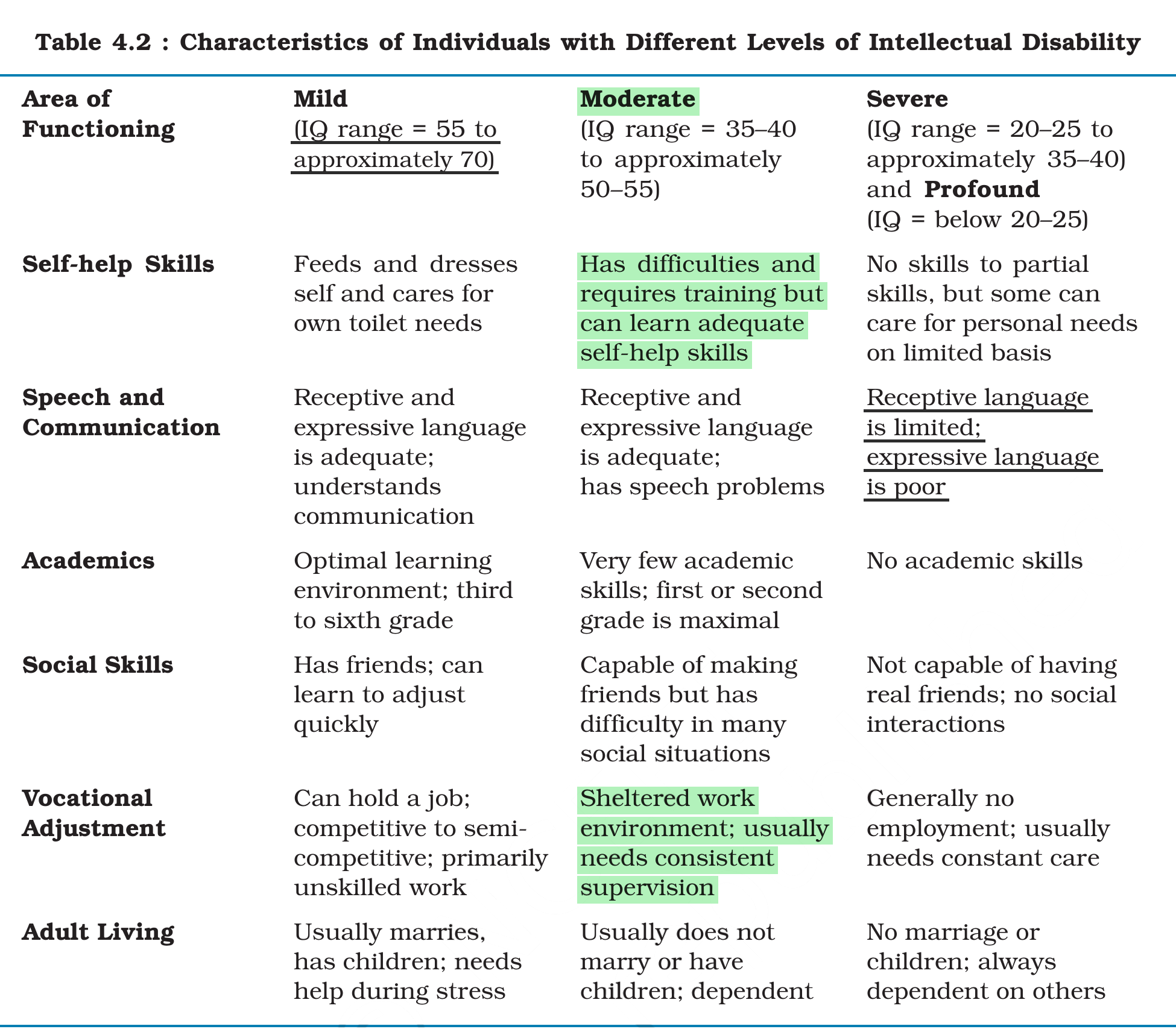
Which of the following statements are correct for an individual with moderate intellectual disability?
(A) They benefit from sheltered work environment and usually need constant supervision.
(B) Receptive language is limited and expressive language is poor.
(C) Their IQ ranges from 55 to approximately 70.
(D) They face difficulties and require training but can learn adequate self-help skills.
Choose the correct answer from the options given below:
Answer & explanation
Correct answer: option 1
The correct answer is Option (1) → (A) and (D) only
Moderate intellectual disability covers IQs from 35–40 to approximately 50–55. These people lag behind their peers in language and motor skills, can be trained in self-care and simple social skills, and need a moderate degree of supervision.
(A) They benefit from sheltered work environment and usually need constant supervision. Correct. For vocational adjustment, the moderate level is described as a sheltered work environment in which the person usually needs consistent supervision.
(B) Receptive language is limited and expressive language is poor. Incorrect. This describes the severe and profound levels. At the moderate level, receptive and expressive language is adequate, though the person has speech problems.
(C) Their IQ ranges from 55 to approximately 70. Incorrect. This is the range of mild disability. The moderate range is lower, 35–40 to approximately 50–55.
(D) They face difficulties and require training but can learn adequate self-help skills. Correct. For self-help skills, the moderate level has difficulties and requires training but can learn adequate self-help skills.
Note: Statement (A) says ‘constant supervision’, while NCERT (2025-26) gives the moderate level ‘consistent supervision’ and keeps ‘constant care’ for the severe and profound levels. The sheltered work environment ties the statement to the moderate level, so it is taken as correct, as per the NTA answer key.
NCERT (2025-26): “Variations of Intelligence … The different levels of intellectual disability are: mild (IQs 55 to approximately 70), moderate (IQs 35–40 to approximately 50– 55), severe (IQs 20–25 to approximately 35–40), and profound (IQs below 20–25). Although the development of people with mild disability is typically slower than that of their peers, they can function quite independently, hold jobs and families. As the level of disability increases, the difficulties are strongly marked. The people with moderate disability lag behind their peers in language and motor skills. They can be trained in self-care skills, and simple social and communication skills. They need to have moderate degree of supervision in everyday tasks.…”
|