Which of the following method can be used for the synthesis of aromatic primary amine only?
Answer & explanation
Correct answer: option 1
The correct answer is Option (1) → Hofmann bromamide degradation reaction
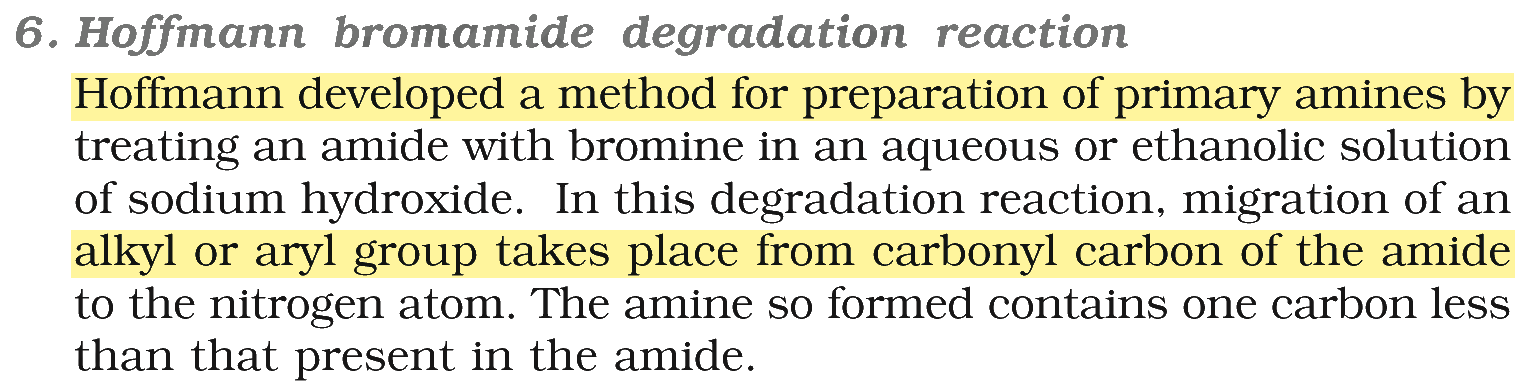
In the Hofmann bromamide degradation, an amide is heated with bromine and aqueous NaOH. The alkyl or aryl group moves from the carbonyl carbon to nitrogen, and a primary amine with one carbon atom fewer is formed:
\( \displaystyle \ce{R-CONH2 + Br2 + 4NaOH -> R-NH2 + Na2CO3 + 2NaBr + 2H2O} \)
R may be an alkyl or an aryl group. With benzamide it gives aniline, an aromatic primary amine:
\( \displaystyle \ce{C6H5CONH2 + Br2 + 4NaOH -> C6H5NH2 + Na2CO3 + 2NaBr + 2H2O} \)
Of the four methods, it is the only one that can give an aromatic primary amine.
Why the other options are incorrect
Option (2) Gabriel Phthalimide synthesis — Incorrect. It gives only aliphatic primary amines. Aryl halides do not undergo nucleophilic substitution with the phthalimide anion, so aniline cannot be made this way.
\( \displaystyle \ce{C6H4(CO)2NK + R-X -> C6H4(CO)2N-R + KX} \)
\( \displaystyle \ce{C6H4(CO)2N-R + 2NaOH(aq) -> C6H4(COONa)2 + R-NH2} \)
Option (3) Carbylamine reaction — Incorrect. This is a test for primary amines (foul-smelling isocyanide with \( \ce{CHCl3} \) and KOH); it uses up an amine instead of making one.
\( \displaystyle \ce{R-NH2 + CHCl3 + 3KOH} \xrightarrow{\text{heat}} \ce{R-NC + 3KCl + 3H2O} \)
Option (4) Kolbe’s reaction — Incorrect. It converts phenol into salicylic acid; no amine is involved.
\( \displaystyle \ce{C6H5ONa} \xrightarrow[\text{(ii) }\ce{H^+}]{\text{(i) }\ce{CO2}} \ce{HOC6H4COOH} \)
NCERT (2026-27 edition):
Hoffmann Bromamide Degradation Reaction